
You’ve watched them spiral. Again.
Maybe they’ve promised you this would be the last time—again. Maybe they’ve told you they don’t need help, or that therapy didn’t work, or that they can stop on their own. And maybe, like so many of us who’ve loved someone in active addiction, you’ve tried to believe it.
Until you couldn’t anymore.
There comes a moment in almost every partner’s journey where you hit the wall. You’ve cried. You’ve yelled. You’ve Googled interventions at 3 a.m. You’ve made spreadsheets, plans, boundaries. And none of it has changed the fact that your person is still using.
That moment—the one where you whisper to yourself, “I’m out of options”—it’s devastating.
But it can also be a turning point.
Because when everything else hasn’t worked, a partial hospitalization program (PHP) may not just be the “next step.” It may be the one that helps them find their footing—and helps you finally exhale.
What Is a Partial Hospitalization Program?
PHP is often misunderstood. It’s not “hospitalization” in the way it sounds—your partner doesn’t live there. But it also isn’t as light-touch as weekly therapy or IOP (intensive outpatient). It’s structured, comprehensive, and clinically supported—but allows participants to go home (or to sober housing) at the end of each day.
PHP typically includes:
- 5 to 6 hours of treatment per day, 5 days per week
- Individual and group therapy
- Medication management (if needed)
- Mental health support (for trauma, depression, anxiety, etc.)
- Case management and discharge planning
- Drug testing and accountability
It’s a level of care that gives your partner enough containment to stabilize—and gives you a break from being their only lifeline.
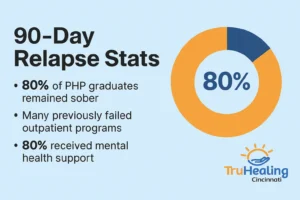
Why PHP Is Often the First Step That Works
By the time many people consider PHP, they’re emotionally, physically, and relationally frayed. Sometimes they’ve tried outpatient or gone cold turkey. Sometimes they’ve cycled through detox and discharge more than once.
What makes PHP effective in those cases is that it:
- Provides daily clinical oversight to address underlying causes
- Establishes a predictable structure, reducing chaos
- Offers peer support without the pressure of residential living
- Makes room for dual-diagnosis care—which many people actually need
And for partners? It gives you space.
Space to think. Space to feel something besides panic. Space to stop walking on eggshells and hoping your love is enough to keep them alive.
PHP Isn’t a Threat—It’s a Lifeline
Let’s say it plainly: You are not crazy for being at the end of your rope.
Addiction warps your relationship into something unrecognizable. You start hiding the truth, even from yourself. You live in a state of chronic adrenaline. You become nurse, therapist, probation officer, and shield—all while pretending everything is fine at work or with your family.
If you’re considering PHP, you’ve likely already tried everything you can as a partner. That doesn’t make you weak. It makes you human. And human beings need help.
TruHealing Cincinnati is here to be part of that help. Whether you’re local or looking for a partial hospitalization program in Lexington, Kentucky, PHP can be the container you both need to reset, re-ground, and begin healing separately before trying to reconnect together.
What Happens If They Say Yes?
If your partner agrees to enter PHP, you can expect:
- A structured weekday schedule—keeping them busy, focused, and supervised
- Daily check-ins with professionals (and sometimes with you, if they consent)
- An intake process that screens for co-occurring mental health needs
- Boundaries—the kind you’ve likely been trying to hold alone for too long
- Progress you can actually feel, not just hope for
This isn’t “lock them away and forget it.” PHP honors autonomy—but with structure. It allows them to be human, but also held accountable. It takes the pressure off you while giving them the intensive care they likely need and may not admit.
What Happens If They Say No?
This is one of the most painful parts of being the partner of someone actively using. You might finally find the right option, make the call, find a program, even get a bed—and they say no.
If that happens:
- You are still allowed to take care of yourself
- You are still allowed to ask for support
- You are not responsible for making them ready
Call anyway. TruHealing Cincinnati can walk you through what your next steps could be. Even if your loved one isn’t ready, you can learn how to hold boundaries that are safe, sane, and survivable.
You can also explore family support groups, therapeutic resources, and safety planning.
And just as importantly? You can grieve.
How to Talk to Your Partner About PHP
If you’re planning to suggest PHP to your partner, try to approach it from a place of calm clarity—not desperation.
Here’s a simple structure:
- Acknowledge your limits: “I know I can’t fix this.”
- Name what you’ve noticed: “You’ve been struggling with [x], and it’s getting worse.”
- Set a boundary: “I can’t keep living in this pattern with you.”
- Offer support, not control: “There’s a program I found—PHP. You’d go during the day but come home at night. It could help.”
It won’t be perfect. They may lash out. They may deflect or minimize. That’s not a reflection of your failure. It’s a reaction born from fear—and the disease of addiction thrives on fear.
Stand your ground with love. And know you don’t have to have all the answers.
FAQ: What Partners Often Ask About PHP
Will I still be involved in their treatment?
Often yes—but only with their consent. TruHealing Cincinnati encourages appropriate family involvement when helpful, especially if it supports long-term recovery.
Can they work or go to school during PHP?
Usually no, not during treatment hours. PHP is typically 6–8 hours per day. But the goal is stabilization—once that happens, returning to work/school becomes a realistic next step.
What if they need medication?
PHP includes medical and psychiatric care. If they need medication support for withdrawal, mood stabilization, or mental health needs, they’ll be assessed and treated accordingly.
Is this inpatient?
No. PHP participants return home or to sober living after each day. It’s intensive—but non-residential.
Will insurance cover it?
In many cases, yes. TruHealing’s admissions team can help check coverage and explain any out-of-pocket costs ahead of time.
You Don’t Have to Live Like This Anymore
Call (888) 643-9118 or visit our partial hospitalization program page to speak with someone who gets it.
You’re not selfish. You’re not dramatic. You’re not overreacting.
You’re someone who loves deeply—and needs help holding the weight of that love.
Whether your partner is ready or not, you are allowed to get support. Starting today.