

There’s a moment many people don’t say out loud—the one where you pause and wonder if getting help might cost you something you’re not ready to lose.
Not your job. Not your routine.
But you.
Your personality. Your creativity. Your way of connecting. The version of you that feels alive, expressive, even if it comes with chaos.
If you’ve been considering taking a step toward change—even something like medication-supported care in Cincinnati—this fear can get louder.
What if I become someone I don’t recognize?
What if I lose what makes me… me?
That fear deserves space. And honesty.
The Part of You That Feels Worth Protecting
For many people, substance use isn’t just about escape. It’s also about access.
Access to confidence.
To emotion.
To creativity.
To connection.
You might feel funnier. More open. Less restricted.
Or maybe it quiets the parts of your mind that feel too loud to live with.
So of course letting it go feels like a loss.
It’s not just about stopping something harmful.
It’s about protecting something meaningful.
And that’s where the conflict lives.
Why Letting Go Can Feel Like Losing Yourself
We’ve seen this pattern again and again.
People don’t resist help because they don’t care.
They resist because they care deeply about who they are.
Especially if you’ve built an identity around how you feel while using.
- The social one
- The creative one
- The one who can finally relax
- The one who doesn’t overthink everything
It can feel like sobriety threatens all of that.
But here’s something important to understand:
What you’re protecting isn’t the substance.
It’s the state of being it helped you reach.
And that state can be rebuilt—without the cost that comes with it.
The Early Shift Feels Strange—And That’s Normal
The beginning of change rarely feels like clarity.
It often feels like quiet.
Or even emptiness.
You might notice:
- Conversations feel harder at first
- Emotions feel unfamiliar or flat
- Your usual “spark” feels distant
- You question if you made the right choice
This isn’t because you’ve lost yourself.
It’s because your brain is recalibrating after relying on something external for so long.
Think of it like stepping out of a loud room.
At first, the silence feels uncomfortable. Almost wrong.
But over time, your senses adjust.
And you start to hear things you couldn’t before.
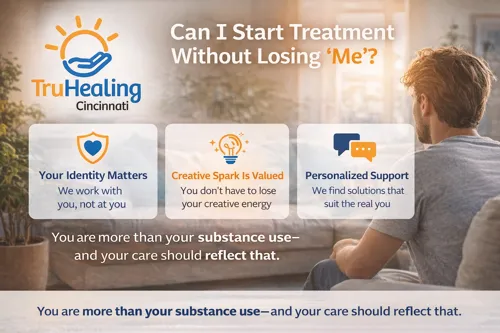
What People Begin to Notice Over Time
Something subtle starts to shift.
Not overnight. Not perfectly.
But steadily.
People often tell us:
- “I feel more like myself—but without the chaos.”
- “I didn’t lose my creativity. It just changed.”
- “I can actually finish things now.”
- “I still laugh. It just feels more real.”
It’s not about becoming less of who you are.
It’s about becoming less dependent on something else to access it.
That’s a very different experience than what most people expect.
You’re Not Meant to Be Replaced
One of the biggest misconceptions about recovery is that it turns people into a completely different version of themselves.
More serious. Less spontaneous.
Detached from who they used to be.
But that’s not what real support is meant to do.
You are not a problem to fix.
You are a person to reconnect with.
The goal isn’t to erase your personality.
It’s to remove what’s been interfering with it.
Sometimes that means rediscovering parts of yourself that got buried.
Other times, it means learning how to express them in a way that actually lasts.
Support That Meets You Without Taking You Over
The right kind of care doesn’t push you into a mold.
It doesn’t strip away your identity or flatten your personality.
It meets you where you are.
For some, that includes options that help stabilize the internal noise—so you’re not constantly fighting cravings or emotional swings while trying to rebuild your life.
That support can create space.
Space to think.
To feel.
To create.
To exist without constantly managing a storm inside your head.
People from places like Lawrenceburg, Kentucky and Lexington, Kentucky often come in carrying this exact fear—that help will take more than it gives.
But what they usually find is something quieter and more surprising.
They don’t lose themselves.
They meet themselves differently.
The Moment It Starts to Feel Like You Again
It doesn’t happen all at once.
There’s no dramatic switch.
It shows up in small, almost forgettable moments:
- Laughing without forcing it
- Finishing a thought without losing it halfway
- Feeling present in a conversation
- Creating something—and recognizing your own voice in it
And then one day, almost unexpectedly, there’s a realization:
I’m still here.
Not the exact same.
But not gone either.
Just… clearer.
You’re Allowed to Want Both Things
You’re allowed to want change and feel afraid of it.
You’re allowed to question whether this will alter parts of you that matter.
That doesn’t make you resistant.
It makes you aware.
And awareness is a powerful place to start.
If you’ve been thinking about taking a step toward addiction treatment cincinnati ohio, or exploring medication assisted treatment cincinnati ohio, it doesn’t mean you’re choosing to lose who you are.
It means you’re choosing to understand yourself without interference.
That’s not loss.
That’s clarity.
FAQs
Will I lose my personality if I stop using?
No—but it may feel different at first. Early recovery can feel quieter or less intense, which some people mistake for losing their personality. Over time, most people find their natural traits return in a more stable and consistent way.
What if substances help me feel creative or social?
That’s a real and valid concern. Many people associate substances with creativity or connection. What often happens in recovery is not the loss of those qualities, but a shift in how they’re accessed—without the crash, dependence, or unpredictability.
Why does early sobriety feel flat or uncomfortable?
Your brain is adjusting. If it’s been relying on substances to regulate mood or energy, it needs time to rebalance. That temporary discomfort doesn’t mean something is wrong—it means your system is recalibrating.
Can treatment respect who I am as a person?
Yes. The right environment should never try to erase your identity. It should support it—while helping you build stability, clarity, and emotional balance.
What if I’m not ready to fully let go?
You don’t have to have everything figured out before you begin. Many people start with uncertainty. What matters is being willing to explore what change might look like for you, at your own pace.
Ready to Talk?
If this fear has been sitting quietly in the background, you don’t have to carry it alone.
Call (513) 429-7900 to learn more about our Medication Assisted Treatment in Cincinnati, Ohio.