
You’re doing fine.
You wake up with your alarm. You answer emails. You show up for your people. You make deadlines, make dinner, make it all work.
You don’t black out. You haven’t been arrested. You’ve never missed a mortgage payment.
So you keep telling yourself what so many high-functioning people do: It’s not that bad.
But here’s the truth—when you need to repeat that line over and over, it’s probably not true anymore.
At TruHealing Cincinnati, we’ve worked with people just like you. People who weren’t falling apart, but weren’t okay either. People who could smile at a conference table and spiral in silence 12 hours later. People who thought they had it under control—until the cracks started showing up in places they couldn’t hide.
This isn’t about shame. It’s about what’s real.
And a residential treatment program doesn’t wait for you to hit rock bottom—it helps you recognize what’s been quietly breaking long before it crashes.
You’re Functioning. But Are You Really Living?
This is the part no one tells you about: addiction doesn’t always look like chaos. Sometimes it looks like achievement. Sometimes it looks like doing everything “right” while quietly building a life that runs on stress, substances, and silence.
You know how to hide in plain sight. You know how to explain things away.
- “Everyone drinks like this on weekends.”
- “I’m just decompressing.”
- “It’s just been a stressful year.”
But underneath the logic, you’ve started to notice a few truths that are harder to ignore:
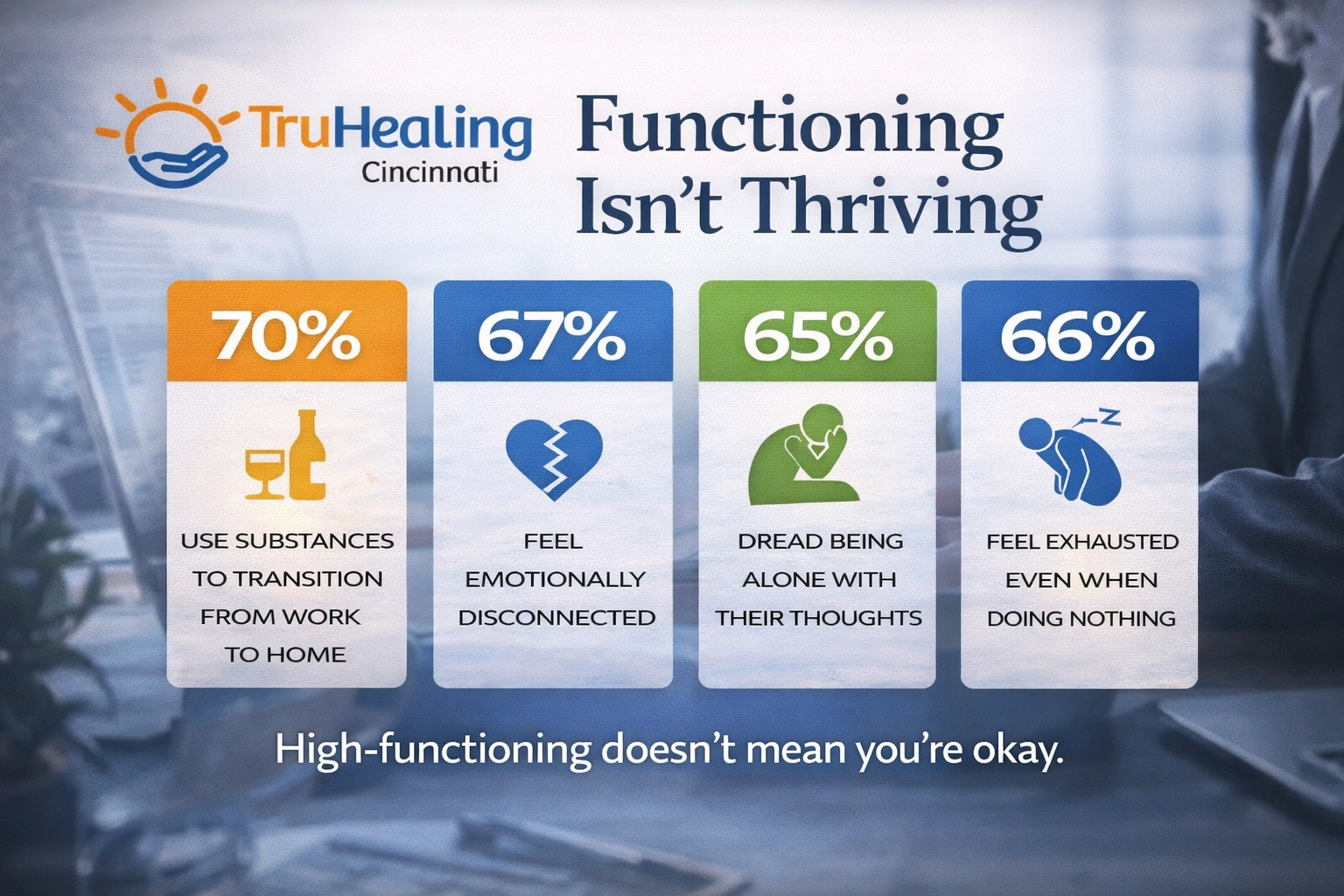
- You’re relying on a substance to transition between work and home.
- You feel emotionally disconnected from things you used to care about.
- You dread being alone with your thoughts.
- You feel exhausted even when you’re doing nothing.
This isn’t about being dramatic. It’s about being honest.
And that’s something residential treatment can help you do—before life forces your hand.
Why High-Functioning People Wait Too Long
You’ve got a reputation to protect. People rely on you. You’ve worked hard for what you have. And the idea of pressing pause—even for a short time—feels terrifying.
We get that. We hear it every day.
But the longer you perform “okay,” the harder it is to admit what you’re really feeling. The further you go, the more the mask sticks. Until one day you look in the mirror and realize you don’t even know who you’re performing for anymore.
Waiting for a crisis doesn’t make you strong.
It makes things harder to repair when they do break.
Treatment doesn’t have to be a last resort. It can be a strategic, compassionate intervention—led by you.
What a Residential Treatment Program Actually Offers
You’re not looking for a lecture. You don’t want to be fixed.
You want to feel like yourself again—before substances took up so much space.
At TruHealing Cincinnati, our residential treatment program offers space to do just that. Here’s what it really looks like:
- Safe medical and psychiatric support if you need detox or stabilization
- One-on-one therapy focused on the emotional function of your substance use—not just the behavior
- Group therapy that helps you realize you’re not the only one holding it together and falling apart
- Evidence-based practices like CBT, DBT, trauma work, and mindfulness
- Nutritional, fitness, and holistic support to help your body recover alongside your mind
- Discreet, compassionate staff who understand what it’s like to live in high-pressure environments
It’s not about labels. It’s about learning how to exist without the constant undercurrent of stress, craving, or emotional shutdown.
You don’t have to lose your job, your family, or your identity to seek treatment. You just have to want something more than survival.
Early Intervention Is Strength, Not Weakness
There’s a belief among high-functioning professionals that help is for people who can’t keep it together.
But what if strength is choosing support before collapse?
What if clarity comes not from pushing through, but from pausing long enough to ask:
- Is this working?
- Is this sustainable?
- Is this actually how I want to live?
You don’t have to wait for the DUI. The hospital. The ultimatum.
You can make a different choice right now—and come out the other side with your dignity intact and your spirit still strong.
That’s what we’ve seen at TruHealing Cincinnati. And it’s what we’re here to offer you.
“Will Treatment Blow Up My Life?”
Let’s be honest: stepping away for care might disrupt things.
But we’ve seen too many people crash everything by doing nothing.
The question isn’t: Will treatment affect my life?
It’s: What happens if nothing changes?
The answer doesn’t have to be dramatic. It might just be:
- A partner who grows distant
- A career that feels more like survival than passion
- A version of yourself you don’t recognize anymore
Treatment doesn’t erase your life. It gives it back to you.
You still get to choose. We just help you see what you’re choosing more clearly.
What If I’m Helping Someone Else See This?
Maybe you’re not the one reading this for yourself. Maybe you love someone who’s doing all the right things… and still slipping.
You’re seeing the 6pm wine that turns into 4pm bourbon.
The missed calls. The hollow eyes. The slow retreat from joy.
We help family members and loved ones explore care for high-functioning professionals and parents all the time.
If you’re looking for a residential treatment program in Louisville, Kentucky, or helping someone who lives in Cincinnati, Ohio, our team can guide you both.
They don’t have to crash to qualify for care.
And neither do you have to carry the weight of watching them fall.
FAQs: Residential Treatment for High-Functioning Adults
Do I have to stop working to attend treatment?
In residential care, you will take a break from work—but we offer professional support for planning time away and integrating recovery into your career path afterward.
What if I don’t see myself as “an addict”?
That’s okay. We’re less interested in labels than in patterns. If your use is affecting your well-being, clarity, or relationships, that’s reason enough to explore care.
Can I attend without anyone knowing?
Your privacy is protected by law. We work discreetly with individuals who require confidentiality due to professional, legal, or public visibility concerns.
How long will I be in residential treatment?
Programs typically last 28–35 days, but we personalize your plan based on your clinical needs and goals.
What happens after I finish the program?
We support you with outpatient options, alumni care, therapy referrals, and reintegration strategies that align with your lifestyle.
Call (888) 643-9118 or visit TruHealing Cincinnati’s Residential Treatment Program to talk confidentially about next steps. It’s not about whether you’ve hit bottom. It’s about whether you want more from your life than what this version of “functioning” is offering you.