
I didn’t think I’d be back here.
That’s the part that stayed with me longer than anything else.
Not the relapse itself. Not even the consequences.
Just that one thought, repeating quietly:
I knew better.
If you’re reading this, there’s a good chance you know exactly what that feels like.
You made it through the hardest part once. You had time. You had clarity. You had proof that change was possible.
And now… you’re here again.
Maybe you’ve even caught yourself looking at something like support for opioid use in Cincinnati and immediately feeling that resistance:
How did I end up back here after everything I learned?
That question carries a lot of weight.
But it’s not the whole story.
The Kind of Shame That Only Comes After Progress
This isn’t the same feeling you had the first time.
The first time, there’s confusion. Maybe denial. Maybe even some distance from what’s really happening.
This time?
It’s sharper.
Because you know.
You know what stability felt like.
You know what it took to get there.
You know the signs you missed—or ignored.
And that creates a different kind of pain.
Not just what happened, but:
I saw this coming and didn’t stop it.
That thought can keep you stuck longer than the relapse itself.
The Moment Things Started Slipping (Even If You Didn’t Call It That)
If you look back honestly, it probably didn’t happen all at once.
It rarely does.
It started small.
Maybe you stopped checking in with people the same way.
Maybe you told yourself you were “fine” when something felt off.
Maybe stress started building faster than you could process it.
Nothing dramatic.
Just small shifts.
The kind that are easy to dismiss in the moment—but clearer in hindsight.
And that’s where the frustration comes from.
Because now you can see it.
Knowing Isn’t the Same as Being Able to Stop
This is one of the hardest truths to accept.
You can understand your patterns.
You can recognize your triggers.
You can even feel the moment things are starting to shift.
And still—not stop it.
That doesn’t mean you didn’t try.
It means that in that moment, something inside you didn’t have enough support to hold the line.
Relapse isn’t a lack of knowledge.
It’s a gap in support at the exact moment you needed it most.
What Actually Broke Down
It’s easy to think everything collapsed.
But usually, it’s more specific than that.
Something gave out.
Maybe it was:
- Emotional overload without an outlet
- Isolation creeping in slowly
- Losing connection to the routines that kept you grounded
- Trying to handle too much internally without saying it out loud
It’s rarely one big decision.
It’s a series of small moments where you carried more than you could hold alone.
And eventually, something had to give.
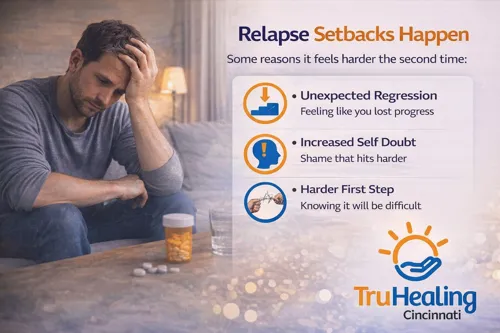
Why Going Back Feels Heavier This Time
The first time, there’s uncertainty.
You don’t fully know what to expect.
This time, you do.
You know what it takes.
You know what it feels like to rebuild.
You know what it feels like to lose progress.
That awareness can make it feel harder to take the first step back.
But it also means something else:
You’re not starting from scratch.
You’re starting with insight.
You Didn’t Lose What You Built
It feels like you did.
Like everything reset.
Like those days, weeks, or months don’t count anymore.
But they do.
The awareness you gained is still there.
The patterns you understand are still there.
The version of you that showed up and did the work—that’s still you.
Relapse doesn’t erase that.
It just interrupts it.
And interruptions can be resumed.
What Changes If You Go Back Now
This time, you don’t have to pretend you don’t know.
You don’t have to hide the parts that feel messy.
You don’t have to act like everything is okay when it’s not.
You can be more direct.
More honest.
More specific about where things started to shift.
That changes the work.
It makes it less about starting over—and more about refining what already began.
You’re Not the Only One Sitting in This Exact Spot
It feels isolating.
Like everyone else figured it out and you didn’t.
But that’s not true.
People from places like Lawrenceburg, Kentucky and Lexington, Kentucky come back carrying this same feeling:
“I should’ve known better.”
And slowly, they start to see something different.
That relapse didn’t make them less capable.
It showed them where they needed more support than they realized.
What If This Isn’t Failure—Just Direction?
It doesn’t feel like direction.
It feels like a setback.
But look at what you know now that you didn’t before:
- Where you tend to isolate
- What stress feels like before it builds
- How your thinking shifts when things start slipping
- What you avoid talking about
That’s not failure.
That’s information.
And information is something you can use.
The Part No One Says Out Loud: You’re Allowed to Come Back
You don’t have to earn your way back in.
You don’t have to explain everything perfectly.
You don’t have to prove that this time is different.
You can just come back.
As you are.
Not as someone who failed.
As someone who’s still willing to try.
And that willingness matters more than anything else.
You’re Closer Than You Think
It doesn’t feel like it.
It feels like you’re further away than ever.
But the truth is:
You’ve already done something incredibly hard once.
That version of you didn’t disappear.
They’re still there.
Underneath the frustration.
Underneath the doubt.
Underneath the noise of this moment.
And getting back to that place?
It’s not about becoming someone new.
It’s about reconnecting with who you already were.
What You Can Do Right Now (Without Overthinking It)
You don’t need a perfect plan.
You don’t need to have everything figured out.
You just need one honest step.
That might be:
- Reaching out
- Saying out loud, “I’m not okay right now”
- Letting someone know where you actually are—not where you wish you were
Small steps matter more than big promises.
Especially right now.
You Don’t Have to Stay in This Moment
This feeling—the shame, the frustration, the doubt—it’s real.
But it’s not permanent.
It only stays if you stay stuck in it.
Movement, even small movement, changes things.
And you’re already closer to that than you think—just by being here.
FAQs
Does relapse mean I failed?
No. It means something in your support or environment wasn’t enough at the time. It’s information—not a final outcome.
Why does this feel worse than the first time?
Because you’re more aware now. You know what’s at stake, and that makes the experience feel heavier—but also more meaningful.
Is it worth going back again?
Yes. You’re not starting over—you’re continuing with more insight than before.
What if I relapse again?
That fear is valid. But each time you return, you gain more understanding. The goal is progress, not perfection.
How do I deal with the shame?
Start by not isolating. Shame grows in silence. Speaking honestly—especially early—can reduce its intensity.
What’s the first step I should take?
Reach out. You don’t need a full plan—just a starting point. Clarity comes after action, not before.
Ready to Talk?
If you’re here—if you’re even considering taking a step back toward support—you’re already moving forward.
Call (513) 429-7900 or visit the page to learn more about our opioid addiction treatment in Cincinnati, Ohio.