
When you’re in early recovery, every hour can feel like a question mark. You’ve put distance between yourself and the substance—but now you’re left face-to-face with anxiety, depression, racing thoughts, or just a dull ache you can’t name. If you’ve ever wondered, “Can residential treatment help if I’m dealing with both addiction and mental health?”—you’re not alone, and you’re asking exactly the right question.
For many people, sobriety brings up emotions that substances once numbed. And without support, that tidal wave can feel like too much to handle. At TruHealing Cincinnati, we know that addiction is rarely just about the substance. It’s about pain, history, brain chemistry, loneliness, and survival strategies that stopped working. That’s why our residential treatment program is designed to care for both your mental health and your recovery.
Let’s unpack the most common questions people have when they’re newly sober, struggling emotionally, and considering a residential level of care.
What if I have anxiety, depression, or trauma and addiction?
You’re not too complicated for help. In fact, dual diagnosis—meaning a co-occurring mental health condition and substance use disorder—is more common than most people realize. For many, the drinking or drug use started as a way to manage unbearable feelings or unprocessed trauma. When the substances are gone, those feelings don’t disappear—they just rise to the surface.
In residential treatment, we don’t separate your mental health from your recovery. We know that healing means addressing both. Whether it’s panic attacks, racing thoughts, numbness, nightmares, or deep emotional lows—we have clinicians and therapists trained specifically to hold space for all of it.
You don’t have to explain away your pain here. You just have to show up.
Will I be judged or labeled because I have a dual diagnosis?
Absolutely not. At TruHealing Cincinnati, we operate from a place of deep understanding, not judgment. Having both addiction and mental health struggles doesn’t mean you’re flawed—it means you’ve been doing your best to survive.
A dual diagnosis is not a character flaw. It’s a call for comprehensive care. And we believe that treating both is not only possible—it’s necessary for real, lasting healing.
Many of our clients feel deep relief when they realize their depression or trauma symptoms aren’t just “bad moods” or “weakness.” They’re legitimate conditions that deserve professional, compassionate treatment—just like the substance use itself.
How does a residential treatment program actually help with both?
A residential treatment program gives you something that’s hard to find anywhere else: uninterrupted time, skilled support, and a safe environment to rest and rebuild.
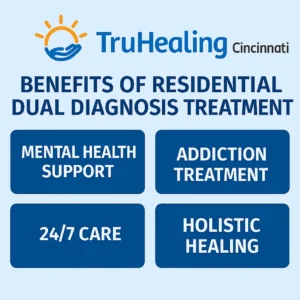
At TruHealing Cincinnati, our residential program includes:
- Mental health support: One-on-one therapy, trauma-informed care, psychiatric evaluation, and medication management if needed.
- Addiction treatment: Daily groups, relapse prevention work, and connection to peers walking a similar path.
- 24/7 care: A structured environment with staff who understand the emotional highs and lows of early recovery.
- Holistic healing: Mind-body practices, expressive therapies, and lifestyle rebuilding—all tailored to support both your mental and emotional health.
You’re not just “checking in” to a program. You’re stepping into a space built to hold the full weight of your experience, and to gently begin setting it down.
What if I’m already feeling isolated—will treatment make that worse?
It’s a fair fear. When you’re feeling emotionally raw and disconnected, it can be terrifying to imagine sharing space with strangers. But many people in early recovery say that residential treatment was the first time they felt truly seen.
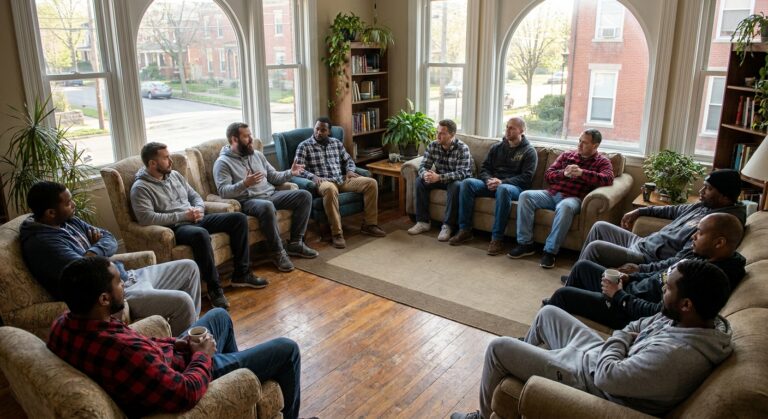
You’re not walking into a crowd of people who don’t get it. You’re stepping into a community of people who understand exactly what you’re going through—even if they say it in different words.
One client told us:
“I spent the first few days keeping to myself, convinced I didn’t belong. Then someone across the table said, ‘I thought I was the only one who felt that way.’ That’s when everything shifted.”
Loneliness doesn’t mean you need to isolate—it means you need the right kind of company. In residential care, you’ll find people who get it, staff who support you, and a daily rhythm that invites connection without pressure.
What if I don’t “look” sick enough for treatment?
This thought—“Other people need this more than I do”—keeps too many people from getting help. You don’t have to be in crisis or falling apart to deserve support. If you’re waking up sober and still feeling lost, overwhelmed, or emotionally unstable, that’s reason enough.
Mental health doesn’t have to be visible to be valid. Emotional pain doesn’t need to reach a certain volume before it counts. If you’re struggling to stay present in your life without substances—and it hurts—that’s more than enough to reach out.
Do I have to leave Cincinnati or Ohio to get dual-diagnosis residential treatment?
Nope. You can get expert, compassionate, dual-diagnosis care right here in Cincinnati. TruHealing Cincinnati is centrally located and easily accessible to surrounding areas. Whether you’re coming from the city or nearby towns like Lawrenceburg or Lexington, you can stay close to home while still getting the intensity of care you need.
Some people worry that staying local means running into triggers—but for many, being close to loved ones and familiar surroundings can actually support the healing process. We help you navigate both, with grounding, individualized plans.
How long do people usually stay in residential treatment?
There’s no cookie-cutter answer. Most residential programs start at 30 days, but your stay might be shorter or longer depending on your needs, goals, and mental health stabilization.
You won’t be pushed out before you’re ready or pressured to stay longer than necessary. Our team works with you to create a treatment plan that respects your healing pace.
Think of it this way: recovery isn’t a race. It’s more like physical therapy for the soul. Some injuries need a few sessions. Others take longer to rebuild strength. Both deserve care.
What if I’ve tried treatment before and it didn’t help?
First, let’s name the heartbreak: trying to heal and still feeling stuck is deeply discouraging. But just because a past program didn’t work doesn’t mean you failed—or that nothing ever will.
Maybe the previous treatment focused only on addiction but ignored your anxiety. Maybe you were in a setting that didn’t feel emotionally safe. Maybe it just wasn’t the right time.
TruHealing Cincinnati takes a different approach. Our dual-diagnosis programming is designed to meet you where you are—not where someone else thinks you “should” be. We don’t rush your process or expect perfection. We create space for the complexity of your healing.
Is residential treatment just another version of being “locked away”?
Not here. At TruHealing Cincinnati, we prioritize dignity, autonomy, and emotional safety. Residential treatment is structured—but it’s not a punishment. It’s a pause from chaos. A chance to reset your nervous system, your story, and your next steps.
You’ll have daily routines, responsibilities, and therapy—but you’ll also have choice, respect, and moments of stillness. For some, that’s the first time life has felt even remotely manageable.
Can I afford this kind of care?
We know that cost can be a barrier—and we’ll never pretend it’s not a big deal. But you may have more options than you think. TruHealing Cincinnati accepts most major insurance providers and our admissions team is here to walk you through every step, from coverage verification to financial planning.
You don’t have to figure this out alone. And you don’t have to delay getting help because you’re unsure about logistics. Let us help you explore what’s possible.
What if I’m not ready—but I’m not okay either?
That’s a real and honest place to be. You don’t have to be 100% certain to start asking questions. You don’t have to feel brave or committed or all-in.
If you’re newly sober and feeling deeply lonely, that’s not a failure of your recovery—it’s a signal. One that says you need more than just abstinence. You need care. You need connection. You need to be reminded that healing is allowed to feel messy.
You don’t have to carry this alone anymore.
Call (513) 429-7900 or visit Residential Treatment Program in Cincinnati to learn how our team can support both your recovery and your mental health.