
You don’t fall apart.
That’s the story.
You keep showing up. You meet deadlines. You handle responsibilities. From the outside, your life still looks intact—maybe even impressive.
But there’s another version of the truth you don’t say out loud:
It’s getting harder to keep this up.
If you’ve quietly found yourself exploring something like safe withdrawal support in Cincinnati, that thought didn’t come out of nowhere.
It came from a moment—maybe small—where you realized:
This isn’t as controlled as it used to be.
The Version of You Everyone Sees
You’re reliable.
That’s your identity.
The one who handles things. The one people count on. The one who doesn’t let things slip.
And because of that, there’s a kind of unspoken pressure:
You don’t get to fall apart.
So instead, you adjust.
You push through fatigue.
You work around it.
You tell yourself it’s temporary.
And for a while, that works.
Until it doesn’t.
The Version of You No One Sees
There’s another side to this that doesn’t show up in conversations.
The mental math.
- How much is left
- When you can have more
- How to get through the next stretch of the day
- How to not let it show
It’s exhausting in a way that’s hard to explain.
Not because your life is falling apart—but because you’re constantly managing something in the background.
It’s like running two lives at once.
One that looks fine.
One that feels like it’s slipping.
Why Success Makes It Easier to Wait
If you were missing work, losing relationships, or visibly struggling, the decision might feel clearer.
But you’re not.
You’re still functioning.
And that creates a dangerous middle ground.
Because things are “working,” it feels reasonable to wait.
To monitor.
To adjust.
To handle it yourself.
But functioning isn’t the same as being okay.
It just means you’ve learned how to carry it.
The Slow Shift You Start to Notice
It doesn’t hit all at once.
It creeps in.
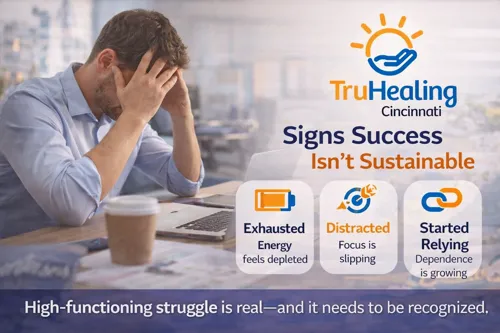
You notice your energy isn’t what it used to be.
Your focus takes more effort.
Your patience is thinner.
Your sleep isn’t really rest anymore.
And maybe the most unsettling part:
You’re starting to rely on it just to feel normal.
That’s usually the point where something inside you pauses.
Not panicked.
Just aware.
The Lie That Keeps You Stuck
“I’ll deal with it when it gets worse.”
It sounds logical.
Controlled. Strategic.
But here’s what I’ve seen, over and over again:
By the time it feels “bad enough,” it’s heavier.
Your body is more used to it.
Your patterns are more fixed.
Your tolerance is higher.
Waiting doesn’t protect you.
It slowly removes your ability to choose.
What High-Functioning Struggle Actually Looks Like
It doesn’t look like chaos.
It looks like control—barely held together.
You’re still succeeding.
Still showing up.
Still getting things done.
But underneath that:
You’re tired in a way that sleep doesn’t fix.
You’re distracted in a way focus can’t correct.
You’re disconnected in a way success doesn’t fill.
It’s quiet.
And because it’s quiet, it’s easy to ignore.
The Moment You Realize It’s Not Sustainable
There’s usually a moment.
Not dramatic. Not loud.
Just a clear, uncomfortable thought:
I can’t keep doing this forever.
That moment matters.
Because it’s not about consequences.
It’s about awareness.
And awareness is often the first real step toward change.
You Don’t Have to Lose Everything to Take This Seriously
This is where a lot of people get stuck.
They wait for a breaking point.
A reason that feels “serious enough.”
But you don’t need to lose your job, your relationships, or your reputation to justify getting help.
In fact, the earlier you act, the more you protect.
Your clarity.
Your stability.
Your sense of control.
People from places like Louisville, Kentucky and Springfield, Ohio often come in still holding everything together on the outside.
And that’s exactly why it matters to act now—not later.
The Shift From Managing to Letting Someone Help
You’ve been managing this on your own.
That’s what you do.
But there’s a difference between managing something and actually resolving it.
Managing keeps it contained.
Support helps you step out of it.
That shift is uncomfortable.
Because it means admitting:
This might be bigger than I can handle alone.
But it also creates something you haven’t had in a while:
Relief.
You Can Be Capable and Still Need Support
This is important.
Needing help doesn’t cancel out your strength.
It doesn’t erase your success.
It doesn’t redefine who you are.
It simply means you’ve reached a point where handling everything alone isn’t working the way it used to.
And recognizing that?
That’s not failure.
That’s clarity.
What Happens When You Act Before Crisis
When you step in earlier, things look different.
You’re not rebuilding from collapse.
You’re recalibrating before things fall apart.
That means:
- Less disruption
- More stability
- A clearer path forward
It’s not about starting over.
It’s about stepping out before this takes more than you’re willing to lose.
You Don’t Have to Be Sure—Just Honest
You don’t have to be 100% certain.
Most people aren’t.
You just have to be honest enough to admit:
Something isn’t right.
And if you’ve been thinking about a Medical Detox Program—even quietly—that thought is worth paying attention to.
Because it usually means part of you already knows:
This isn’t as manageable as it used to be.
FAQs
Can you still need help if everything looks fine?
Yes. High-functioning individuals often struggle the longest because things don’t visibly fall apart. That doesn’t mean everything is okay—it just means it’s hidden.
Why do successful people wait longer?
Because they can. Functioning allows you to delay action, even when things are getting harder internally.
What’s the risk of waiting too long?
Patterns become more ingrained, dependence can increase, and it may take more effort to stabilize later.
Do I need to hit a breaking point first?
No. Acting early often leads to better outcomes and less disruption overall.
What if I’m not sure it’s “bad enough”?
If you’re thinking about it, that’s enough to explore. You don’t need a worst-case scenario to justify support.
Is it possible to handle this on my own?
Some people try for a long time. But if it’s been getting harder, that’s usually a sign that additional support could make a real difference.
Ready to Talk?
If something in you is recognizing that this isn’t as manageable as it used to be, you don’t have to wait for it to get worse.
Call (513) 429-7900 or visit the page to learn more about our Medical Detox Program in Cincinnati, Ohio.