
There’s a moment that comes up often in sessions. It doesn’t arrive loudly. It slips in between sentences, usually softened with a shrug or a quiet laugh.
“What if I lose my edge?”
If you’ve been thinking about getting help—even just exploring something like therapy support in Cincinnati—this question might feel closer than you expected.
And it’s not a surface-level concern. It’s personal. Identity-level. The kind of fear that doesn’t go away just because someone tells you it’ll all be okay.
The Version of You That Feels Alive Right Now
When people talk about their “edge,” they’re rarely talking about just one thing.
It might be the way you think—fast, layered, unconventional.
It might be your ability to feel deeply, to access emotion without hesitation.
It might be your humor, your boldness, your ability to connect in a way that feels magnetic.
Or maybe it’s simpler than that.
Maybe it’s just the version of you that feels uninhibited.
The version that doesn’t overthink every word.
The version that can walk into a room and feel like you belong there.
And if substances have played a role in helping you access that version of yourself, even temporarily, it makes sense that letting go feels like a risk.
Not just a behavioral change.
A personal one.
Why This Fear Deserves to Be Taken Seriously
There’s a tendency to dismiss this fear.
To say things like, “You’ll be better without it,” or “You’ll find yourself again.”
But if you’re sitting with this question, those answers can feel too simple. Even invalidating.
Because from your perspective, this isn’t about becoming “better.”
It’s about not becoming someone you don’t recognize.
It’s about protecting the parts of you that feel real, expressive, meaningful.
And as a clinician, I want to be clear:
That instinct—to protect your identity—is not something we want to override.
It’s something we want to understand.
What I Often Say in That Conversation
I don’t promise that everything will feel the same.
It won’t.
But I do say this:
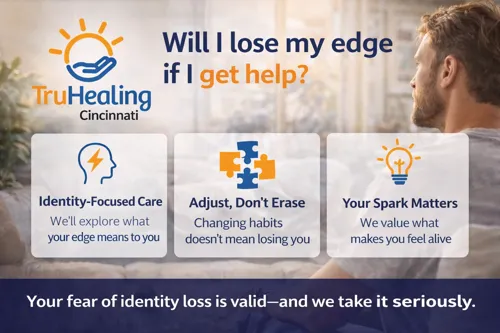
“You’re not going to lose your edge. You’re going to change your relationship with it.”
That difference matters.
Because what most people are afraid of is disappearance.
What actually happens is adjustment.
And adjustment, while uncomfortable at first, opens up something more sustainable than what you’ve been relying on.
The Early Phase: When Things Feel Off
Let’s talk about the part people don’t always expect.
In the beginning, things can feel… quiet.
Sometimes too quiet.
- Thoughts slow down
- Emotions feel unfamiliar
- The intensity you’re used to isn’t there
- You might question if you’ve lost something important
This is where doubt often creeps in.
Was that part of me real?
Or was it just the substance?
The truth is—it was real.
But it was being accessed through something that also came with instability, unpredictability, and cost.
What you’re feeling now isn’t loss.
It’s recalibration.
What Starts to Rebuild (Even If You Don’t Notice Right Away)
As the noise settles, something else begins to take shape.
Not louder.
Not more dramatic.
Just more steady.
People begin to notice:
- They can follow through on ideas, not just have them
- Their emotions feel less chaotic, even if they’re still deep
- Their creativity becomes more consistent
- Their connections feel more grounded
It’s not the same experience as before.
But it’s often more sustainable.
And that’s where people start to feel a different kind of confidence—not the kind that spikes and crashes, but the kind that holds.
You Are Not Being Replaced
One of the most common misconceptions I hear is this:
“I don’t want to become boring.”
Underneath that is a deeper fear:
“I don’t want to become someone I’m not.”
But what I see, over and over again, is not people becoming less themselves.
It’s people becoming less dependent on something else to feel like themselves.
Your personality doesn’t disappear.
Your humor doesn’t flatten.
Your depth doesn’t vanish.
What changes is the instability around those things.
And for many people, that stability actually allows those qualities to grow.
The Work Is About Access, Not Removal
Therapy isn’t about taking things away from you.
It’s about helping you access what matters—without it costing you your peace, your health, or your sense of control.
That might mean learning new ways to reach emotional depth.
It might mean building tolerance for discomfort instead of escaping it.
It might mean reconnecting with parts of yourself that have been buried under survival patterns.
For individuals coming from places like Louisville, Kentucky and Springfield, Ohio, this fear shows up in deeply personal ways.
But the pattern is often the same.
They don’t lose what they value.
They learn how to experience it without losing themselves in the process.
The Quiet Moments Where It Becomes Clear
There’s no single turning point where everything clicks.
Instead, it shows up in small, almost forgettable moments.
You laugh—and it doesn’t feel forced.
You create—and it feels like yours.
You sit in a conversation—and you’re actually present for it.
And then, maybe later, you notice something subtle:
You’re not trying as hard to feel like yourself.
You just… do.
That’s often when people realize:
Nothing essential was taken from me.
If anything, something was returned.
You Can Be Both Afraid and Curious
You don’t have to eliminate your fear to move forward.
You don’t have to convince yourself that everything will be perfect.
You can be uncertain and still explore what change might look like.
If you’ve been thinking about addiction therapy cincinnati ohio, it’s okay if part of you is holding back.
That hesitation usually means you’re paying attention to something important.
And that’s not a barrier.
That’s a starting point.
What If Your Edge Isn’t Something You Can Lose?
It’s worth considering this:
What if your edge was never the substance?
What if it was always you—your mind, your perspective, your way of experiencing the world?
And what if the work ahead isn’t about giving that up…
…but learning how to access it without something that eventually started taking more than it gave?
That shift—from fear to curiosity—is where many people begin.
FAQs
Will sobriety make me less interesting?
This is one of the most common fears. What usually happens is not a loss of personality, but a shift in how you express it. Many people find they become more consistent, present, and authentic over time.
What if I rely on substances to feel creative?
That connection can feel very real. But creativity doesn’t disappear—it often becomes more stable and less tied to emotional highs and lows. It may feel different, but not diminished.
Why does everything feel flat at first?
Your brain is adjusting. If it’s been used to external stimulation or regulation, it needs time to rebalance. That temporary flatness is part of the process, not the outcome.
Can I still be myself in therapy?
Yes. Therapy should support your identity, not replace it. The goal is to help you feel more grounded within yourself—not disconnected from who you are.
What if I’m not ready to fully commit?
You don’t have to have everything figured out. Many people start with questions, hesitation, and curiosity. That’s enough to begin exploring.
Ready to Talk?
If this question has been sitting quietly in your mind, you don’t have to answer it alone.
Call (513) 429-7900 or visit the page to learn more about our addiction therapy in cincinnati ohio.