

You didn’t plan to stop showing up.
Maybe life got messy—work pressure, family chaos, a rough night that turned into a rough week. Maybe it wasn’t dramatic at all. Just one missed session. Then another. Then the shame rolled in, whispering that it’s “too late to go back.”
If that’s where you’re sitting right now—wondering if you blew your shot at healing—you need to hear this:
You didn’t.
And the door’s not just open. It never closed.
At TruHealing Cincinnati, we work with people every single day who paused treatment, relapsed, ghosted, or just plain disappeared. There’s no scarlet letter for that. Just life—and your next step.
If you’re thinking about coming back but aren’t sure if a partial hospitalization program (PHP) is right for you, here’s a grounded guide to help you figure that out. No judgment. Just real questions, real options, and a reminder: you’re still allowed to heal.
1. You left IOP, but your symptoms didn’t leave you
You might’ve left treatment thinking you could handle it on your own. And maybe for a while, you did. But lately, the signs are creeping back in:
- You’re overwhelmed more often than not
- Your substance use is no longer “just once in a while”
- You’re avoiding people who care because you don’t want to explain
- Your emotions feel too big, too sharp, too much to manage alone
- Life feels blurry again—and not in a poetic way
If this sounds familiar, it doesn’t mean you’re failing. It means your nervous system is waving a white flag.
PHP can help. With structured, full-time support during the day, and the freedom to go home at night, it meets you right where you are: still standing, still struggling, still trying.
2. IOP felt like too much—or not enough
Sometimes IOP (Intensive Outpatient Program) doesn’t hit the mark.
It might’ve been too demanding too soon. Or not structured enough to hold you when things got heavy. Maybe you were juggling too much—work, family, recovery—and the pieces just didn’t fit.
PHP can offer a better fit for where you are now. It’s more immersive than IOP, which means:
- Daily therapy instead of a few sessions a week
- More emotional and clinical support when things get rough
- Time to stabilize before managing outside triggers
It’s not about “starting over.” It’s about getting what you actually need to move forward.
3. You feel isolated—and tired of pretending you’re okay
Leaving treatment can get lonely fast.
The support system you started building? Gone. The routine? Gone. The accountability and connection? You guessed it—gone.
And when you don’t feel great, but you also don’t want to admit how bad it’s gotten, you can get stuck in the middle. That awkward, heavy silence of “I’m not okay, but I don’t know how to ask for help again.”
PHP is a place where you can stop pretending. No need to clean up your story. No need to over-explain why you left. At TruHealing Cincinnati, and in nearby areas like Lawrenceburg or Lexington, Kentucky, you’ll find people who get it. Clinicians who’ve seen every version of this. And peers who are still showing up, even when it’s messy.
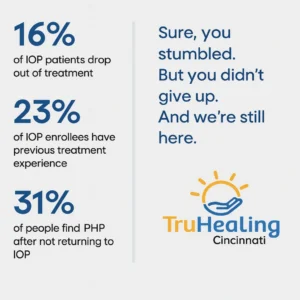
4. You’re ready for more support—but not a locked-down setting
Maybe you’ve thought about going back to residential treatment, but it feels like too much. Or maybe you’re not in crisis—but you can feel yourself drifting toward one.
PHP is often the ideal middle ground:
- You get structure and intensity without feeling trapped
- You live at home or in sober housing
- You rebuild daily habits in real-time, not in a vacuum
- You stay connected to your life, but with backup
This model works especially well for folks who need a reset after dropping out, but aren’t looking for inpatient care.
5. You’re wondering if anyone wants you to come back
Let’s speak to the fear out loud: “Do they even want me back?”
Yes. 100 times yes.
At TruHealing Cincinnati, we don’t keep score. Your treatment history isn’t a tally of successes and failures—it’s information. If IOP didn’t work out, it just means we need to try something different. That’s not shameful. That’s smart care.
We won’t make you retell your worst day. We’ll meet you wherever your next day starts.
6. You’re thinking about it—which means you’re closer than you think
You might not feel “ready.” But thinking about returning to treatment at all is a sign something in you still believes you’re worth saving.
And you are.
That flicker of “what if I tried again?” is often the turning point. You don’t have to be sure. You just have to be curious.
And if that’s where you are right now, PHP could be exactly the kind of support that lets you follow through.
FAQs: Coming Back After Dropping Out of IOP
Can I still come to PHP if I ghosted IOP or left on bad terms?
Yes. Many clients return to care after dropping out or stepping away. You don’t need to justify it. We’ll help assess what level of care fits best now.
Is PHP more demanding than IOP?
It’s more structured—but also more supportive. PHP usually involves 5 days a week of therapy, group work, and psychiatric care. You’ll still have evenings at home.
What if I’ve relapsed—do I have to detox first?
That depends on your current symptoms. We can help assess if medical detox is necessary before starting PHP. If not, you can usually enter directly.
Will I be judged for leaving my last program?
Absolutely not. We treat dropout as a detour, not a failure. What matters now is that you’re here.
Do you offer PHP near me if I’m not in Cincinnati?
If you’re looking for a partial hospitalization program in Louisville, Kentucky, or surrounding areas, we may be able to connect you to nearby support or provide referrals.
What if I don’t want to explain everything again?
That’s okay. We focus on what you need today—not making you retell every step. Your story is valid, no matter how incomplete it feels.
It’s not too late to restart
You don’t have to fix everything before asking for help. You don’t have to be “ready enough.” You just have to be willing to start where you are.
If your IOP dropout left you feeling lost, disconnected, or unsure if you’re still allowed back in—know this:
You are.
Call (888) 643-9118 to learn more about Partial Hospitalization Program in Cincinnati, Ohio.
No judgment. Just support.
We’ll be here when you’re ready.