

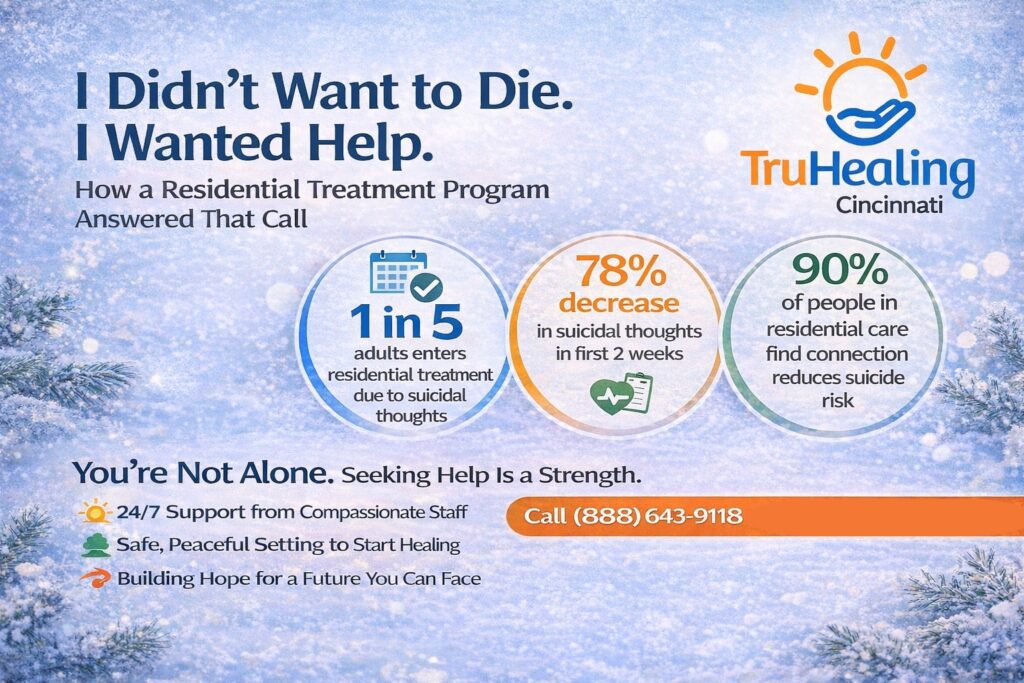
I didn’t want to die.
What I wanted was the pain to stop. Or at least to soften.
That distinction matters more than most people realize. Because for many people living with suicidal thoughts, the desire isn’t for death—it’s for relief. Relief from the constant pressure. From the looping thoughts. From the quiet exhaustion of waking up every day already overwhelmed.
At TruHealing Cincinnati, we meet people in this exact space. People who are scared by their thoughts but still holding onto life. People who don’t know how to ask for help without sounding “dramatic.” People who don’t want to disappear—they just don’t want to keep living like this.
That’s where our Residential Treatment Program comes in. Not as a last resort. But as a place to land when staying alive feels harder than it should.
When Suicidal Thoughts Are a Signal, Not a Decision
Suicidal ideation isn’t always loud. Often, it’s quiet and persistent. It shows up as thoughts like:
- “I can’t do this forever.”
- “Everyone would be better off without me.”
- “I just want it all to stop.”
These thoughts don’t mean you truly want to die. They mean something inside you is overwhelmed and running out of ways to cope.
Many people feel ashamed of this gray area. They worry they’ll be misunderstood—or pushed into emergency measures they don’t feel ready for. That fear keeps them silent. And silence is where suffering grows.
A Residential Treatment Program creates space to talk about these thoughts safely, honestly, and without panic. You don’t have to convince anyone how bad it is. We believe you the first time.
Why Residential Treatment Can Help When Everything Feels Too Heavy
Residential care isn’t about fixing you. It’s about holding you when you can’t hold yourself anymore.
In our residential program, you’re not expected to function at full capacity. You don’t have to make major life decisions. You don’t have to explain your pain perfectly. You’re allowed to slow down.
This level of care offers:
- 24/7 support, so you’re never alone with intrusive thoughts
- A stable, predictable environment that calms an overstimulated nervous system
- Daily structure when motivation and energy are depleted
- Time away from triggers, pressures, and expectations that feel unbearable
For many people, the biggest relief is knowing someone else is watching the edges—so they don’t have to.
“I Was Afraid You’d Think I Was Overreacting”
We hear this often.
People worry they’ll be told their thoughts aren’t “bad enough” for residential care. Or that they’ll be judged for not having a clear plan or intent.
But suicidal ideation doesn’t need to reach a breaking point to deserve care. If your thoughts scare you—even quietly—that’s enough.
Residential treatment is appropriate when:
- You feel emotionally unsafe being alone
- Coping skills aren’t working anymore
- You’re exhausted from managing symptoms on your own
- You need consistent support to stabilize and breathe again
You don’t have to prove how much you’re hurting. Wanting help is reason enough.
What Daily Life Looks Like in a Residential Treatment Program
People often imagine residential treatment as cold or clinical. In reality, it’s human.
Days include a balance of:
- Individual therapy focused on safety, understanding, and stabilization
- Group therapy where you hear, “I thought it was just me”
- Time for rest, reflection, and grounding
- Supportive routines that rebuild trust in your body and mind
There’s no pressure to “get better” quickly. Healing isn’t linear, especially when suicidal thoughts are present. Some days are quiet. Some days are emotional. All of them are allowed.
One client described it this way:
“It was the first place where I didn’t have to pretend I was okay just to survive the day.”
Safety Comes Before Answers
When someone is struggling with suicidal ideation, the first goal isn’t insight or growth—it’s safety.
At TruHealing Cincinnati, we focus on:
- Creating emotional and physical safety
- Reducing immediate distress
- Helping you feel grounded in the present moment
Only after safety is established do we begin exploring the deeper layers—what led you here, what’s been weighing on you, and what support you’ll need moving forward.
You don’t have to solve your life to deserve peace. Sometimes, the bravest thing is letting someone help you stay.
Connection Is the Opposite of Suicidal Isolation
Suicidal thoughts thrive on isolation. They convince you that you’re different. Broken. Alone.
Residential treatment gently challenges that lie.
In group settings, people hear their own thoughts spoken out loud by someone else. They realize their pain makes sense in context. Shame softens. Loneliness loosens its grip.
You don’t have to be social or outgoing. You just have to be present. Even quiet connection can be life‑saving.
Care That Extends Beyond Cincinnati
We support individuals not only from Cincinnati, but also from nearby communities. Many people come to us from surrounding states because they need a setting where care feels steady and personal.
If you’re looking for residential treatment support in Lawrenceburg, Kentucky, our team regularly works with individuals from that area and helps coordinate care seamlessly.
Distance doesn’t have to be a barrier to safety.
You Don’t Have to Want to Live Forever—Just Today
One of the gentlest truths we share is this:
You don’t have to commit to a lifetime. You just have to stay.
Residential treatment helps people focus on right now. On getting through the next hour. The next day. The next breath.
Hope doesn’t arrive all at once. Sometimes it starts as relief. As rest. As someone sitting with you while the thoughts pass.
That’s enough to begin.
Frequently Asked Questions About Residential Treatment and Suicidal Ideation
Is residential treatment only for people in immediate crisis?
No. Residential treatment is appropriate for people who feel emotionally unsafe or overwhelmed—even if they’re not in immediate danger. It’s about prevention, stabilization, and support before things escalate.
Will I be forced to stay if I admit I’m having suicidal thoughts?
No. Treatment is collaborative and respectful. Our goal is to help you feel safe and supported, not trapped. Care decisions are made with you, not to you.
What if I don’t know how to explain what I’m feeling?
You don’t have to. Many people come in saying, “I don’t know what’s wrong—I just can’t do this anymore.” That’s enough to start.
Can residential treatment help if I feel numb, not emotional?
Yes. Emotional numbness is a common part of suicidal ideation. Treatment focuses on gently reconnecting you to yourself at a pace that feels manageable.
How long do people typically stay in residential treatment?
Length of stay varies based on individual needs. Some people need a few weeks to stabilize; others benefit from longer support. We adjust care based on progress and comfort.
What happens after residential treatment?
We help create a transition plan that may include outpatient care, therapy, or community support. You won’t be sent back to life without a bridge.
You’re Allowed to Ask for Help Before You Break
If you’re reading this and thinking, “I don’t want to die—I just don’t want to live like this anymore,” we want you to hear this clearly:
That feeling is valid. And it’s treatable.
You don’t have to wait until things get worse. You don’t have to explain your pain perfectly. You don’t have to do this alone.
Call (888) 643-9118 or visit to learn more about our Residential Treatment Program services in Cincinnati, Ohio.
We’re here to help you stay. And to help things feel possible again.