

When Sobriety Starts to Feel… Distant
You’re still sober. You’re working. Sleeping. Doing the things you’re supposed to do.
But lately, something feels off.
You’re not in crisis. But you’re not really living either. It’s like the light has dimmed, and you can’t remember the last time you felt lit up from the inside. You’re going through the motions. You’re checking the boxes. But something real feels… out of reach.
If that sounds like you, you’re not broken—and you’re not alone. At TruHealing Cincinnati, we talk to long-term alumni all the time who quietly hit this place. Not a relapse. Not chaos. Just a slow drift into emotional disconnection.
And here’s the good news: you don’t have to stay stuck.
Whether your residential treatment program was three months ago or three years ago, your recovery deserves continued care. Sometimes, the next right step isn’t starting over—it’s reconnecting with deeper, long-term stability support.
Here are five signs that might be the case for you.
1. You’re Sober, But You Feel Numb
This one shows up quietly.
You’re not triggered to use. You’re not actively depressed. But it’s like your emotional bandwidth has shrunk. You don’t feel joy. Or clarity. Or connection. You just feel… dull.
Maybe you’ve stopped reaching out. Maybe you’re still showing up to meetings, but nothing really lands anymore. You laugh politely. You nod at the right time. But you feel a hundred miles away from yourself.
This is incredibly common for people in sustained recovery. Especially for those who did the work early and did it fast. Sometimes, emotional numbness is your nervous system asking for a slower, deeper layer of healing.
That doesn’t mean something went wrong in your last program. It just means recovery is still unfolding—and support may need to look different this time.
2. You’ve Drifted from the Person You Were Becoming
Think back to who you were in treatment—not at your lowest, but when things started to click. When you had a breakthrough in group. When you wrote something down in your journal and surprised yourself. When you told the truth and someone said, “Me too.”
Now ask yourself: do you feel connected to that version of yourself now?
Long-term recovery isn’t just about staying sober. It’s about staying close to your purpose, your self-awareness, and your growth. If that feels out of reach—or like it belongs to someone you used to be—it may be time to re-anchor.
A structured support track or return to clinical care doesn’t mean you’re failing. It means you care enough to keep becoming the person you glimpsed in your first round of healing.
3. You’re Showing Up—But It Doesn’t Feel Like It Matters
You’re going to work. You’re calling your sponsor. You’re keeping up with your routine.
But it’s all muscle memory now. You do the next right thing because that’s what you’ve trained yourself to do. And that’s a good thing—it’s why you’re still sober.
But there’s a difference between surviving recovery and living it.
When everything starts to feel like an obligation—when your calendar is full but your heart feels empty—it might be time to change the conversation. Maybe what you need isn’t more structure, but more meaning inside the structure you already have.
And meaning often shows up when you sit still, reflect deeply, and let someone walk with you through the stuckness. That’s what long-term support is for.
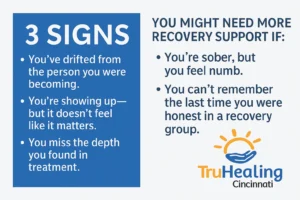
4. You Can’t Remember the Last Time You Were Honest in a Group
This one hits hard.
You’re still attending recovery groups or therapy. You still check in. You know what to say. But when was the last time you actually told the whole truth?
Not just “I’ve been feeling disconnected lately.”
But “I’m scared this is all there is.”
Not just “I’ve been working a lot.”
But “I feel hollow and I don’t know why.”
If you’ve stopped telling the truth—or stopped knowing how—you haven’t failed. You’ve just gotten tired.
Recovery takes emotional energy. And sometimes that energy runs low. What you need isn’t guilt. It’s space—to feel again, speak again, and be reminded you’re not carrying this alone.
5. You Miss the Depth You Found in Treatment
It’s not that you want to go back to the beginning. It’s that you miss the depth.
The way your residential treatment program held you. The way you felt known. The way time slowed down enough for real change to happen.
You don’t necessarily need 30 days away again—but maybe you need a season of slowness, structure, and being seen again.
That’s why we offer long-term support options tailored to alumni. Whether that’s clinical refreshers, short-term check-ins, or a re-entry track inside our residential treatment program in Cincinnati, we’ll help you re-engage with your recovery in a way that honors how far you’ve already come.
You Don’t Have to Be in Crisis to Ask for Support
This is the myth that keeps so many people stuck:
“If I’m not falling apart, I shouldn’t need help.”
But here’s the truth: you don’t have to be unraveling to be deserving of care.
In fact, some of the strongest recoveries come not from bouncing back after a crisis—but from catching the drift before it becomes distance. Before the flatness becomes despair. Before the disconnection becomes relapse.
You don’t need to explain or justify where you are. You only need to be willing to say, “I don’t want to stay here.”
If you’re looking for a residential treatment program in Lawrenceburg, Kentucky or exploring long-term support near Lexington or Louisville, we can help you find your way back—without shame, pressure, or judgment.
FAQs: Long-Term Stability Support After Treatment
Do I need to go back to residential treatment to get help?
Not necessarily. Some alumni benefit from short-term refreshers, others from alumni-specific outpatient services, and others from a return to structured residential care. We help you decide based on what you need—not a one-size-fits-all model.
What does “long-term stability support” actually mean?
It means recovery care that helps you stay emotionally and mentally connected—not just sober. This could include ongoing therapy, trauma processing, psychiatric support, or alumni check-in tracks.
Will I lose my progress if I return to treatment?
No. You are building on your progress, not erasing it. In fact, returning with more insight often makes treatment more effective—not redundant.
What if I feel embarrassed asking for more help?
That’s common—and it fades quickly once you step back into supportive care. We’ve had hundreds of alumni return after 6 months, 1 year, even 5 years. No one judges you for being brave enough to keep growing.
What if I’m still doing “everything right” but feel off?
That’s exactly when to reach out. Support isn’t just for people in visible crisis. It’s for people who feel themselves slipping internally, even if everything looks fine on the outside.
You’ve Made It This Far—Now Let’s Keep Going
You didn’t come this far to feel empty.
You didn’t fight your way through the chaos of addiction to arrive in a life that feels flat and disconnected. You deserve more.
And wanting more doesn’t mean you’re ungrateful. It means you’re alive. It means you still believe in the possibility of feeling whole—not just sober.
If that spark feels far away, we’ll help you find it again.
Because you don’t have to do this alone. And you don’t have to settle for quiet suffering in long-term recovery.
Want to Reconnect With Your Recovery in a Deeper Way?
Call (888) 643-9118 or visit our Residential Treatment Program page to learn how TruHealing Cincinnati supports alumni seeking renewed stability, connection, and purpose.