

It doesn’t take a dramatic exit to leave treatment.
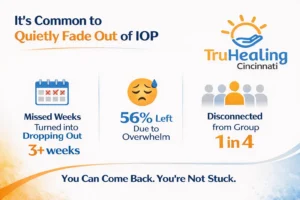
Sometimes you just stop showing up. You silence the calendar reminders. You tell yourself, “I’ll reschedule next week.” Then one week becomes three. And just like that, you’ve ghosted your intensive outpatient program (IOP).
No explosions. No relapses, even. Just a quiet fade-out you weren’t expecting.
If that’s what happened—or something like it—I want you to know something up front:
You’re not the only one. You’re not beyond help. And you’re not stuck.
It’s normal to have mixed feelings about treatment. It’s normal to step away when things get hard. But if part of you is still wondering if you left for the wrong reasons… let’s talk about what that might mean.
1. You thought “not being ready” was a dealbreaker
Maybe you showed up to IOP your first week, hoping for clarity—and instead felt overwhelmed, unsure, or flat. Maybe you sat in group and thought, “I don’t belong here.” Maybe the content wasn’t clicking, or you didn’t feel connected to the people around you.
That doesn’t mean it wasn’t working. It means you were still warming up.
Readiness doesn’t mean confidence. It means showing up despite uncertainty.
A lot of people leave IOP because they’re waiting to feel “more ready.” More certain. More deserving. More something.
But treatment works best when you give it room to work before it feels natural. If you left IOP because you were chasing a feeling that hadn’t arrived yet—you might’ve left just before the shift was about to happen.
2. You were overwhelmed—and no one knew
IOP isn’t light. It’s a big emotional commitment. You’re showing up for group, one-on-one therapy, sometimes psychiatry. You’re opening up to strangers about the hardest things in your life—and doing it multiple times a week.
For some people, that’s empowering. For others, it’s terrifying.
If you left because it was too much, too fast—you’re not alone. Overwhelm is a real reason to pause. But that doesn’t mean the treatment itself was wrong. It might mean you didn’t have enough support inside the process.
At places like TruHealing Cincinnati, that’s something we can talk about openly. Maybe your IOP needs a slower entry. Maybe your group needs to shift. Maybe it wasn’t you—it was just the setup.
Overwhelm doesn’t mean failure. It means more structure or flexibility might be needed.
3. You were scared of being seen—and didn’t know how to say that
You might not have quit IOP because it wasn’t helpful. You might’ve left because it was.
Sometimes, the moment you start getting honest is the moment you panic. Maybe you shared something in group that felt too raw. Maybe your therapist asked a question that hit too close. Maybe your walls started to crack—and that scared you more than staying sick ever did.
Here’s the quiet truth a lot of people never say out loud:
Sometimes it’s safer to self-destruct than to be vulnerable.
That fear is real. And you’re not broken for having it.
But you deserve a place where you can move through that fear at your pace—not bolt the moment things get too honest. IOP can be that place—if you’re ready to let the right people hold space for you, even when it’s awkward or messy.
4. You were trying to protect your “normal”
Treatment messes with routine.
Even with outpatient care, you’re committing several hours a week to something that isn’t your job, family, or social obligations. And for high-functioning people especially, that disruption can feel threatening.
If you left IOP because it felt like too much of an interruption, that’s valid. You’ve built a life that “works” on the outside. The idea of tearing into that—even temporarily—can trigger panic.
But ask yourself this:
Is your normal still serving you? Or is it just familiar?
If you were drinking more than you wanted to…
If you were snapping at people you love…
If you were faking calm while internally unraveling…
Maybe “normal” wasn’t working as well as you hoped.
And maybe leaving IOP was more about fear of change than it was about readiness to manage things alone.
5. You didn’t click with your group—but assumed all groups are the same
A lot of people leave IOP because their group felt off. Maybe it was too quiet. Maybe too intense. Maybe you just couldn’t relate to anyone in the room.
That’s enough to shake anyone’s confidence.
But one group isn’t every group.
You don’t have to stay in a space that doesn’t feel safe. But you also don’t have to give up on treatment just because your first group wasn’t a match.
Programs like TruHealing Cincinnati—and even IOPs in Lexington or Louisville, Kentucky—offer support in reshaping your care environment. You deserve a group where you feel safe, seen, and able to show up as you are.
6. You still think about going back
This is the one that matters most.
If you’ve moved on… but not really…
If you’ve returned to old habits… but they feel emptier than before…
If you find yourself revisiting memories of your time in treatment, wondering what would’ve happened if you stayed…
That’s not nostalgia. That’s your nervous system remembering what it felt like to be held.
You don’t owe anyone an explanation. You don’t have to make a grand entrance or prove you’re “serious this time.”
You just have to answer the quiet voice in you that still wants something better.
FAQs About Coming Back After Leaving IOP
Can I come back if I ghosted or left early?
Yes. Absolutely. You won’t be punished, shamed, or made to explain everything. The door is still open—and always will be.
What if I’m using again—do I have to detox first?
It depends on how much and how recently. Some people can re-enter IOP directly. Others might need a short detox first. We’ll help you figure that out safely.
Will I be judged for leaving the first time?
Not here. Many of us have left programs, paused recovery, or restarted multiple times. We normalize re-entry. What matters is that you’re here now.
Is there support for making it work with my schedule?
Yes. TruHealing Cincinnati offers morning and evening IOP options, and some nearby programs in Lawrenceburg, Kentucky or surrounding areas may offer hybrid flexibility too.
Do I have to start all over?
Not necessarily. We’ll pick up where you left off and reassess what kind of support feels realistic now. It’s not a reset. It’s a restart—with more understanding than before.
You didn’t burn the bridge. You just paused the path.
You don’t need to be punished. You don’t need to explain everything. You don’t need to prove you’re worthy of coming back.
If something in you is still thinking about IOP—trust that.
Call (888) 643-9118 or visit our intensive outpatient program page to learn more about how TruHealing Cincinnati supports re-entry, second starts, and healing that meets you where you are.
We’ll be here when you’re ready.