

You didn’t fail. You stumbled.
You showed up once. Twice. Then life got loud. Work, family, stress, sleep, bills, errands — all of it got in the way. Before you knew it, you hadn’t been back to your intensive outpatient program in a week… or three.
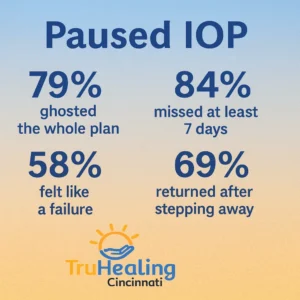
We’ve heard clients say it feels like a quiet unraveling: One missed session turns into silence. One skip feels small — until suddenly you’ve ghosted the whole plan.
If that sounds like you, take a breath. You’re not alone. And you’re not done.
At TruHealing Cincinnati, we’ve helped people who stepped away from IOP rebuild routines that stick — not by forcing perfection, but by building consistency one grounded choice at a time. And that’s what this guide is about: How to build a routine that keeps you consistent in IOP without overwhelming your life.
Why Routines Matter More Than Motivation
Motivation is like the morning sun — bright, warm, and gone by noon.
Routine? That’s the steady pulse underneath it all.
A good routine doesn’t rely on how you feel.
It works even when motivation dips, doubt creeps in, or stress presses heavy.
Especially for someone who’s walked away before — hesitation, fear, shame, worry about judgment — a predictable rhythm helps you show up before judgment or fear even has time to form.
Routine keeps you anchored. It says:
Come back tomorrow. And the next day.
Even when you don’t feel like it.
Step 1: Start with One Daily Anchor
If you try to overhaul everything at once, most people stall. So let’s keep the beginning simple.
Pick one thing you will do every day that connects to your recovery.
It might be:
- Checking your IOP schedule each morning
- Sending a brief “I’m here” text to your clinician
- Journaling one line about how you feel before group
- Drinking a glass of water before leaving for a session
The point isn’t perfection — it’s consistency.
One small anchor builds confidence. And confidence builds momentum.
Step 2: Schedule IOP Like an Appointment — Not a Suggestion
One of the biggest traps is treating sessions like suggestions rather than appointments.
When IOP feels optional, it becomes easy to skip.
Try this:
- Put each session into your calendar with alerts
- Treat it like a doctor’s visit — not a social invitation
- Add reminders 15 minutes before and 5 minutes before
When it’s on your calendar, it becomes real.
Not someplace you might go — someplace you will go.
Step 3: Create a Pre‑Session Ritual
Routine isn’t just about showing up — it’s about preparing to show up.
Try a short ritual before group:
- Make a cup of tea or coffee
- Sit quietly for one minute
- Take three slow breaths
- Write one sentence in a notebook: “Today I want to feel…”
You don’t need hours.
You just need intention.
This primes your nervous system. It sends a message:
This is my time.
I’m here for a reason.
Step 4: Pair IOP with Something You Already Do
Consistency is easier when your routine ties into something already automatic.
Examples:
- After brushing your teeth in the morning, review your IOP plan
- After dinner, spend two minutes thinking about what you’ll share in group
- On the way to sessions, play a calming playlist you associate with recovery
Routine thrives on repetition.
Repetition thrives on familiarity.
Find what’s already familiar — and tie your recovery to it.
Step 5: Make Recovery Visible — Not Hidden
Out of sight, out of mind is real. Especially when life gets chaotic.
So make your routine visible.
Options:
- Write your IOP days on a whiteboard at home
- Keep a small recovery checklist on the fridge
- Use a calendar app that shows daily progress
When you see your routine, your brain starts to respect it.
And every time you check a box, your brain gets a tiny reinforcement — a signal that says:
You can do this.
Step 6: Build in Gentle Accountability
Accountability doesn’t have to be heavy. It can just mean connection.
Try:
- Asking a friend or family member to ask how your session went
- Sending a short message to your clinician after group
- Setting up a weekly check‑in with a recovery partner
Consistency doesn’t happen in isolation.
It happens in connection.
And connection gently reminds you why you started.
Step 7: Expect Missed Days — and Plan for Them
Some days you’ll be exhausted. Or overwhelmed.
Or life will just dump a big distraction in your path.
And that’s okay.
What matters is not perfection — it’s what you do next.
If you miss a day:
- Don’t punish yourself
- Don’t avoid contact
- Reach out and reschedule
Say something simple:
“I missed yesterday. I want to get back on track today.”
That’s all it takes.
Consistency isn’t one perfect streak — it’s the willingness to restart when you lose ground.
Success Stories: Real People, Real Routines
A.J.’s Turnaround
A.J. had dropped out of IOP twice because he felt “too busy.” When he came back, we worked with him to build tiny anchors — checking his schedule each morning and texting his counselor before group. Two weeks later, A.J. reported that showing up had become automatic — not exhausting.
Lila’s Ritual
Lila struggled with anxiety before sessions. We helped her create a pre‑session ritual: three deep breaths, a short affirmation, and a quiet 60‑second walk. She started to associate IOP with calm — and attendance shot up.
Dante’s Visible Progress
Dante put his calendar on the fridge. Every day he checked off attendance, and at the end of the week, he could see how far he’d come. For the first time, his routine felt like progress — not pressure.
These success stories didn’t happen because people were perfect. They happened because they built habits that held them gently, steadily, and without judgment.
FAQs: Building a Routine That Keeps You Consistent in IOP
Do I have to rebuild my entire life to be consistent?
No. You only need one reliable anchor at first. Start small, stay steady, and add more routine elements gradually.
What if I feel overwhelmed by scheduling?
Keep it simple. Start with reminders, then add small rituals. You don’t need a full planner — just one step you can repeat.
Is consistency more important than intensity?
Yes. Showing up regularly — even imperfectly — builds more trust and growth than sporadic perfection.
What if I miss multiple sessions?
Missing sessions happens. What matters is reconnecting. Reach out, reschedule, and gently step back into your routine. We’ll meet you where you are.
Can accountability be gentle?
Absolutely. Accountability doesn’t need pressure — it needs connection and encouragement. You get to choose who holds space with you.
What if I feel ashamed about ghosting?
You don’t need to apologize in a dramatic way. A simple message like, “I got overwhelmed and stepped back. I want to try again,” is enough. We’re here to help — not judge.
Looking for an Intensive Outpatient Program in Cincinnati, Ohio?
If you’ve stepped away from your recovery, you’re not alone — and you’re not stuck. It just means the routine you had didn’t stick yet. And routines can be rebuilt.
Whether you’re in Cincinnati, or coming from nearby places like Lawrenceburg, Kentucky or Lexington, Kentucky, you can return to a program that’s not just supportive — it’s structured in a way that meets you where you are right now.
You don’t have to be perfect to be consistent.
You just have to come back. And we’ll help you stay.
Ready to build a routine that keeps you consistent in IOP?
Call (888) 643‑9118 to learn more about our intensive outpatient program services in Cincinnati, Ohio.