
From the outside, your life works.
You show up.
You perform.
You handle what needs to be handled.
And because of that, no one asks questions.
But there’s something you don’t say out loud:
It’s getting harder to keep it all running.
Not in a dramatic way.
In a slow, steady pressure that never really lets up.
If you’ve found yourself here—looking into support for opioid addiction treatment while still managing your life—you’re not imagining that tension.
You’re living inside it.
You don’t look like you’re struggling—and that’s the problem
High-functioning addiction hides well.
Not because it’s small.
Because it’s controlled.
You’ve figured out how to:
- Keep your responsibilities intact
- Avoid obvious consequences
- Stay just within the lines of what people consider “normal”
And because of that, no one interrupts you.
No one says, “Hey, something’s off.”
So you keep going.
But inside, it feels different.
Like you’re constantly adjusting—just enough to stay ahead of being found out.
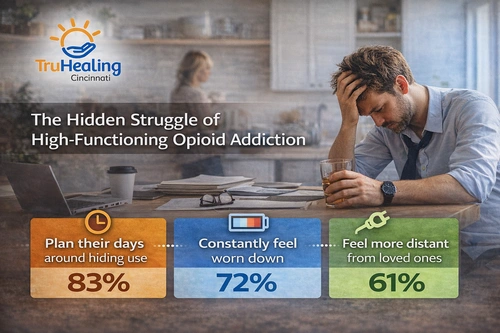
The effort it takes to look “fine”
People don’t see the management.
They don’t see:
- The mental math around timing and use
- The way you plan your day around staying functional
- The quiet rules you’ve created to keep everything from slipping
From the outside, it looks like control.
From the inside, it feels like maintenance.
And maintenance is exhausting.
Not in a way you can sleep off.
In a way that builds.
Success becomes the thing that traps you
If things were falling apart, it might be easier.
At least then, the problem would be obvious.
But success changes the equation.
It tells you:
- “You’re fine. Look at everything you’re handling.”
- “This isn’t that serious—you’re still functioning.”
- “You don’t need help. You just need to manage it better.”
And that voice is convincing.
Because it’s backed by evidence.
You are functioning.
But functioning is not the same as being okay.
What starts to slip—quietly
High-functioning doesn’t mean unaffected.
It just means the impact is less visible.
Over time, things start to shift:
- You feel more irritable than you used to
- Your energy drops, even when you’re doing the same things
- You need more just to feel “normal”
- You feel slightly disconnected—even when everything is going well
It’s subtle.
But it’s consistent.
And it doesn’t go away on its own.
The moment people usually don’t talk about
There’s a point that isn’t dramatic.
No crisis. No collapse.
Just a thought:
“Why does this feel harder than it should?”
That’s it.
That’s the moment things start to change.
Not externally—but internally.
Because once you notice that something feels off, it’s hard to ignore it completely.
You’re not losing control—you’re running out of space
Most people expect addiction to look like chaos.
But in high-functioning cases, it looks like tightening.
Your margin shrinks:
- Less patience for stress
- Less flexibility when things go wrong
- Less room to just exist without needing something to adjust how you feel
You’re still holding everything together.
But with less space.
And that’s where the pressure builds.
What we see behind the scenes
We’ve worked with people who look like they have everything handled.
Careers. Families. Responsibilities.
People others rely on.
And when they sit down, they don’t say, “I’ve lost everything.”
They say:
“I’m tired of keeping this going.”
That’s the truth underneath high-functioning addiction.
Not collapse.
Sustainability.
Or rather—the lack of it.
We’ve seen individuals from Springfield, Ohio come in saying they weren’t “bad enough” to need help—only to realize how much of their life had been shaped around maintaining something they no longer wanted to carry.
That realization doesn’t come from failure.
It comes from honesty.
You don’t need to hit a breaking point to take this seriously
This is where most people wait too long.
They wait for something undeniable.
Something that forces the issue.
But you don’t need that.
You’re allowed to respond to:
- Exhaustion
- Disconnection
- The feeling that something isn’t right
Those are enough.
You don’t need a crisis to justify change.
What changes when you stop doing this alone
Here’s what people don’t expect.
They think getting help means losing control.
But what often happens is the opposite.
They feel:
- Less pressure to maintain appearances
- Less need to constantly calculate
- More space to actually think and feel clearly
Not because everything is fixed.
But because they’re not carrying it by themselves anymore.
That alone can shift more than people realize.
The part that hits the hardest
Let’s be direct.
You’re not “getting away with it.”
You’re managing it.
And managing it takes something from you every single day.
Energy. Attention. Presence.
Pieces of yourself that don’t come back automatically.
The longer it goes on, the more normalized it feels.
But normal doesn’t mean sustainable.
Frequently Asked Questions
Can you really have a problem if everything in life still looks stable?
Yes.
External stability doesn’t always reflect internal reality.
You can meet expectations and still be struggling in ways that aren’t visible to others.
Why does it feel so hard to admit this?
Because you’ve built an identity around being capable and in control.
Admitting something is off doesn’t fit that identity easily.
What if I don’t feel “bad enough” to get help?
That’s common.
But waiting until things get worse isn’t a requirement.
You’re allowed to respond to what you’re feeling now—not what it might become later.
Will getting help disrupt everything I’ve built?
Not in the way you might think.
Many people find that addressing this actually helps them maintain what matters—without the constant strain.
How do I know if I’m just overthinking it?
If it keeps coming up, you’re not overthinking.
You’re noticing something real.
And that’s worth paying attention to.
What’s the first step if I don’t want to blow up my life?
You don’t have to.
The first step can be a conversation. A question. A quiet decision to explore options.
It doesn’t have to be drastic to be meaningful.
There’s a version of your life where you’re not constantly adjusting, calculating, or holding everything together behind the scenes.
Not perfect.
Just lighter.
And if something in you is starting to question whether this is sustainable—that’s not weakness.
That’s awareness.
Call (513) 429-7900 or visit our opioid addiction treatment in Cincinnati to learn more.