
For some people, a new diagnosis brings a strange kind of relief.
For others, it brings something heavier: confusion, fear, even panic.
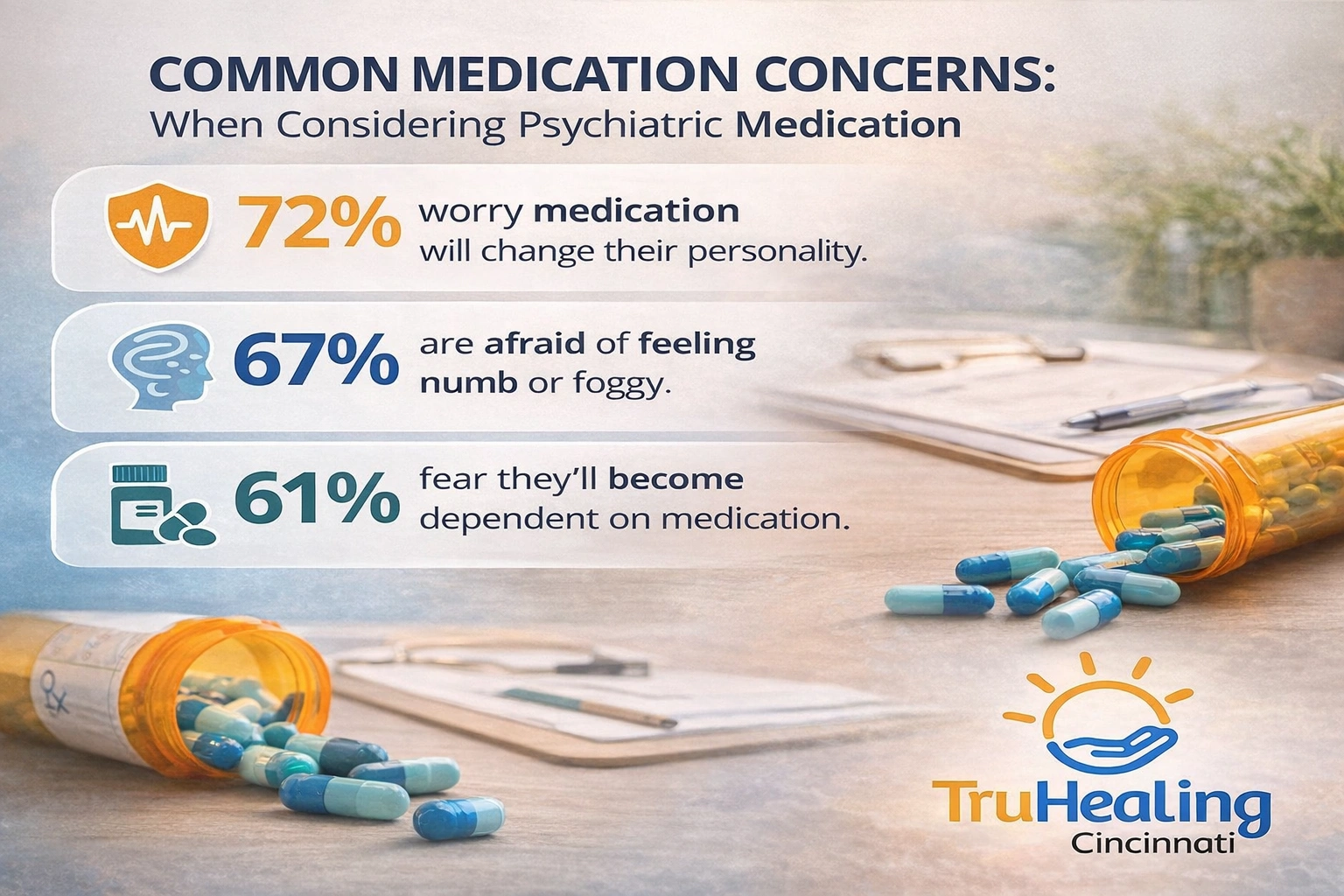
You finally have a name for what you’ve been struggling with—anxiety, depression, bipolar disorder, PTSD—but now there’s a prescription sitting in front of you, and you’re supposed to say yes.
But what if you’re not ready?
What if medication changes something in you?
What if you feel numb, foggy, or disconnected?
What if it helps… but it also takes something away?
At TruHealing Cincinnati’s Residential Treatment Program, we hear these concerns every day—and we hold them with respect.
Medication is not just a chemical decision.
For many, it’s an identity decision. A trust decision. A “what now?” kind of decision.
And in our experience, fear doesn’t mean you’re not ready.
It means you care about who you are—and you want to stay connected to that.
Fear of Medication Doesn’t Mean You’re Being Difficult
Let’s name this gently: many newly diagnosed clients worry that saying “I’m scared” will be interpreted as resistance, denial, or noncompliance.
We see it differently.
In our residential treatment program, fear is not a red flag—it’s a door.
It tells us that your relationship to your body, your mind, and your sense of control matters to you. And we take that seriously.
Maybe someone in your life pushed meds on you too quickly.
Maybe you’ve seen friends lose their spark.
Maybe you’ve internalized the message that needing medication makes you weak.
Whatever your story is, it’s yours.
And you deserve to process it in an environment that respects your pace and your personhood.
What Happens When You Say “I’m Not Sure”
In some treatment settings, uncertainty is seen as a problem to fix.
At TruHealing Cincinnati, it’s seen as part of the process.
Here’s what it actually looks like when you’re newly diagnosed and unsure about starting medication:
- You meet with a licensed medical provider—not just once, but regularly
- You’re encouraged to ask questions—without being rushed or dismissed
- You learn about your diagnosis—in plain, clear language
- You’re part of the decision—every step of the way
- You’re supported whether you say yes, not yet, or no
No one here will force a pill into your hand.
No one will override your voice.
Instead, we build trust together.
One client said it best:
“I didn’t feel like a case number. I felt like a person who mattered—even when I didn’t have all the answers.”
Medication Isn’t the Whole Story—It’s One Tool
There’s a common fear we hear:
“If I start medication, will I have to stay on it forever?”
Or:
“Does this mean I’m broken?”
The short answer is no.
Medication is a tool—sometimes a temporary one, sometimes a long-term support. It’s not a sentence, and it’s definitely not a shortcut.
In our residential treatment program, we use medication to support therapy, not replace it. For clients struggling with severe depression, panic, or mood dysregulation, medication helps lift the weight just enough for the therapeutic work to begin.
Think of it like this:
- If therapy is a trail, medication is the walking stick.
- If therapy is building a house, medication is the leveler—steadying the ground so the foundation can hold.
Some people stay on meds for a while. Some taper off safely. Some discover that a small, consistent dose keeps their system regulated for years.
But none of that is decided in a vacuum. It’s always done in partnership—with you.
From Hesitation to Clarity: Real Client Journeys
We’ve walked beside hundreds of clients through the “do I or don’t I?” medication decision. The stories are unique, but the emotional thread is often the same:
“I was terrified I’d lose myself.”
“I thought I’d feel flat or fake.”
“I didn’t want to become dependent on something outside of me.”
And here’s what many of them later said:
- “It helped me think clearly for the first time in years.”
- “My emotions are still here. They’re just not crashing into me all day.”
- “I finally had the energy to do the real work in therapy.”
Medication didn’t erase who they were.
It made space for them to come forward—with less overwhelm and more stability.
We’ve seen this happen not only in Cincinnati, but also at our nearby partner sites—like our residential treatment program in Lawrenceburg, Kentucky. The care is consistent. The approach is human. The focus is always on empowering you—not managing you.
What If You’ve Had a Bad Experience Before?
You might be reading this thinking, “I already tried meds. It didn’t go well.”
That matters.
In our intake process, we ask about your medication history—not just what you took, but how it felt, what went wrong, and what you’re afraid of repeating.
Then we adjust.
Maybe you were overmedicated.
Maybe you weren’t monitored closely.
Maybe the wrong combination left you feeling worse, not better.
We won’t repeat what didn’t work. And we won’t pretend there’s only one way to feel better.
You deserve options. And you deserve a care team that listens deeply before offering them.
Taking the First Step Doesn’t Mean Saying “Yes” to Everything
This is what often surprises people: you can begin healing without making every decision on day one.
In our residential treatment program, you don’t have to “be ready.” You just have to be open to exploring what readiness might feel like.
Here’s what that could look like:
- Spending your first few days settling in, not deciding anything
- Meeting one-on-one with your psychiatrist to explore—not commit
- Joining a group where others talk about their own medication fears
- Trying one dose, then checking in to see how it feels
- Saying “not yet,” and being told “that’s okay”
This is slow medicine. This is patient-centered care. This is how we help people move from fear to clarity—without losing themselves in the process.
If you’re near Springfield, Ohio, and looking for a program that honors that pace, our residential treatment program in Springfield, Ohio might be another option to explore.
Our Commitment to You
We believe:
- You are not your diagnosis.
- Medication is a tool, not a mandate.
- You deserve to feel safe in your own mind.
- Consent and education come before any prescription.
- Hope should never come with pressure.
We also believe that fear is not weakness. It’s a sign that something matters to you. And it deserves our respect.
That’s how we treat every client who walks through our doors—especially those unsure of what comes next.
FAQ: Medication Support in Residential Treatment
Do I have to take medication to receive treatment?
No. Medication is one option among many. Some clients benefit from it, others don’t need it. We’ll help you explore what’s right for you—with no pressure.
How soon will I know if a medication is helping?
Some meds begin working within days; others take a few weeks. That’s why ongoing monitoring is key. We check in with you often and make adjustments as needed.
What if I don’t like how I feel on it?
You are always encouraged to speak up. If something doesn’t feel right, we change the plan. Your voice is central to the process.
Will I still feel like myself?
Yes. In fact, many clients report feeling more like themselves—less foggy, less anxious, more present. The goal is clarity, not numbing.
Can I stop medication if I want to later?
Yes, but always under medical guidance. We’ll support you in tapering safely, with a plan that respects your goals and well-being.
You’re Not Alone—And You’re Not Broken
Being scared to start medication doesn’t mean you’re failing. It means you’re human.
At TruHealing Cincinnati, we’ll never shame your hesitation or rush your decisions. We’ll walk with you—at your pace, with your consent—toward a version of life that feels safer, steadier, and still fully you.
Let’s Talk—Without Pressure.
Call (888) 643-9118 to learn more about our to learn more about our Residential Treatment Program in Cincinnati, Ohio.
You don’t have to have it all figured out. You just have to start where you are.