
You finished.
Not halfway. Not barely.
You actually did it.
You showed up when you didn’t want to. You sat through things that were uncomfortable. You stayed when leaving would’ve been easier.
And now you’re here.
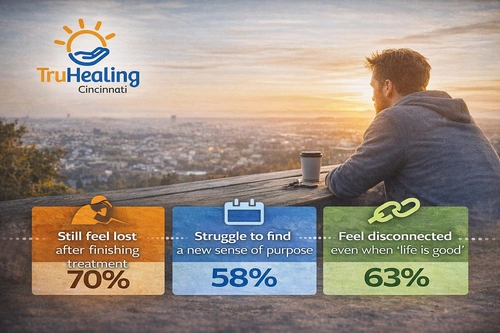
Life is… stable.
But something feels off.
Not in a loud, chaotic way.
In a quiet, persistent way that’s harder to explain:
“Why do I still feel lost?”
If you’ve been through support for opioid addiction treatment and ended up in this space, you’re not the only one.
And you’re not doing recovery wrong.
The part no one really warned you about
There’s a version of recovery that gets talked about the most.
You get clean.
You rebuild.
You feel better.
And yes—some of that is true.
But there’s another layer that shows up later.
A quieter one.
Where things are technically “okay”… but you don’t feel connected to your life the way you expected to.
You’re not in crisis.
But you’re also not fully here.
That gap can feel confusing—especially after everything you’ve already done.
You didn’t just stop something—you lost something
Even if it was destroying you, it was still part of your life.
Your days had a rhythm.
Your emotions had an outlet.
Your identity—even if it was chaotic—was familiar.
When that’s gone, there’s space.
At first, that space feels like relief.
Then it starts to feel like something’s missing.
Not because you want to go back.
But because you haven’t built something new to hold that space yet.
Structure held you—and now it’s gone
During treatment, there’s a kind of support that’s hard to recreate on your own.
You had:
- A schedule
- People checking in
- Clear expectations
- A sense of direction
You didn’t have to figure everything out—you just had to show up.
Then you step back into real life.
And suddenly, it’s on you.
No one is telling you what to do next.
No one is structuring your day.
And that freedom? It can feel less like freedom and more like pressure.
This is where a lot of people go quiet
Not relapse.
Not breakdown.
Just… quiet.
They stop talking about how they feel because:
- “I should be grateful.”
- “I already made it through the hard part.”
- “Other people have it worse.”
So they push it down.
And from the outside, everything looks fine.
But inside, there’s a slow drift.
You’re not missing the old life—you’re missing intensity
This is one of the most confusing parts.
You might catch yourself thinking:
“Was I more alive back then?”
And that thought can scare you.
But let’s be clear:
You’re not missing the damage.
You’re missing the intensity.
Addiction creates extremes—high highs, low lows, constant movement.
Now things are… level.
And level can feel unfamiliar.
Almost like something is missing.
But what’s actually happening is your system is stabilizing.
And stability doesn’t always feel good right away.
What we’ve seen in people further down this road
We’ve worked with people who hit this exact phase months—or even years—after finishing care.
People from Knoxville, Tennessee who came in not because they were using again, but because they felt disconnected from their own lives.
They would say things like:
“I did everything right. So why does this feel so empty?”
And the answer wasn’t that something was wrong.
It was that they had reached the part of recovery no one explains well:
The part where you have to build a life—not just remove a problem.
This stage isn’t about stopping—it’s about building
Early recovery is about stopping something destructive.
This stage is different.
It’s about:
- Creating purpose without chaos driving it
- Learning how to feel without escaping it
- Building routines that actually mean something
That’s a different kind of work.
And it doesn’t come with the same urgency.
Which makes it easier to avoid.
Why it feels harder than it “should”
You might think:
“I already did the hard part. Why does this still feel difficult?”
Because this part requires something different.
Not survival.
Not endurance.
Intention.
You have to choose:
- How you spend your time
- What matters to you
- Who you want to be without crisis shaping it
And that’s not something anyone can hand to you.
It has to be built.
Slowly.
You’re not broken—you’re in transition
That feeling of being stuck?
It’s not a dead end.
It’s a transition point.
You’re no longer who you were.
But you’re not fully connected to who you’re becoming yet.
That space in between can feel:
- Uncertain
- Flat
- Disorienting
But it’s not permanent.
It’s unfinished.
What actually helps people move through this
Not motivation.
Not waiting for clarity to magically show up.
What helps is small, consistent movement.
Things like:
- Reconnecting with people—even when it feels awkward
- Trying things without expecting them to “fix” anything
- Building routines that support your day instead of just filling time
It’s not dramatic.
But it works.
Because it creates something real to stand on.
The truth most people avoid saying
You didn’t do all of that work just to feel like this.
But this feeling?
It’s part of the process.
Not the reward.
Not the end.
Just the next phase.
And if you ignore it, it lingers.
If you face it, it shifts.
Frequently Asked Questions
Why do I feel lost even after finishing treatment?
Because removing something from your life creates space—and that space needs to be filled with something meaningful over time.
Until then, it can feel like disconnection.
Is this a sign I’m going to relapse?
Not necessarily.
Feeling disconnected doesn’t mean you’re going backward.
It means you’re in a phase where deeper work is needed.
How long does this stage last?
There’s no fixed timeline.
It depends on how you engage with it.
Avoiding it can make it last longer. Leaning into it helps it shift.
What should I focus on right now?
Not perfection.
Focus on small, consistent actions—connection, routine, and honest reflection.
Why does life feel less exciting now?
Because you’re no longer operating in extremes.
Stability can feel unfamiliar at first—but over time, it becomes something you can actually build on.
What if I feel like nothing matters?
That feeling is more common than people admit.
It usually means you haven’t reconnected with purpose yet—not that purpose doesn’t exist.
You’re not back at the beginning.
You’re further than that.
But you’re also not finished.
And this part—the quiet, uncertain, disconnected part—is where things either stall… or deepen.
You don’t have to figure it out alone.
Call (513) 429-7900 or visit our opioid addiction treatment in Cincinnati to learn more.