
There’s a kind of fear that doesn’t leave, even when your child finally agrees to get help.
It doesn’t quiet down after the intake call.
It doesn’t disappear when they walk through the doors.
If anything, it shifts into something heavier:
“What if this still isn’t enough?”
If you’re a parent sitting with that thought, you’re not overreacting. You’re not being negative.
You’re seeing the reality of how serious this is—and how much is at stake.
If you’ve been looking into support for opioid addiction treatment, it’s important to understand both sides of this honestly: the risk, and the reason hope still exists.
The truth most people soften—but you deserve to hear clearly
Let’s not tiptoe around it.
Getting help does not instantly remove overdose risk.
That’s the part that’s hardest to accept.
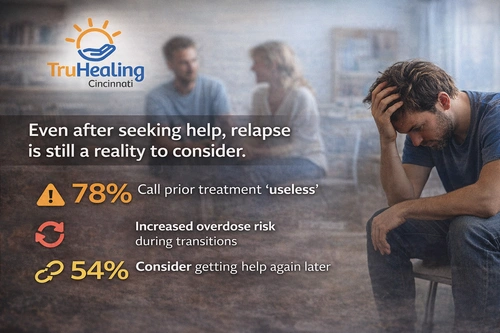
In fact, there are moments—especially during transitions—where the risk can increase if the right supports aren’t in place.
This isn’t because your child is failing.
It’s because of how the body and brain respond after periods of stopping or reducing use.
Tolerance drops.
That means if someone returns to the same amount they used before, their body can’t handle it the same way.
That’s where danger lives.
It’s not comfortable to hear.
But understanding it gives you something most parents don’t have in the beginning:
Clarity.
Why “they’re getting help now” doesn’t calm the fear
You might have thought that once your child agreed to get help, you’d feel relief.
And maybe you did—for a moment.
But then the next thought came:
“Okay… but what happens after?”
That question is valid.
Because help isn’t a single event.
It’s not one decision that fixes everything.
It’s a process that has to continue, adapt, and stay connected over time.
When that continuity is there, things start to change.
When it’s not, risk can return quickly.
The most vulnerable moments aren’t always the obvious ones
Most people think the highest risk is during active use.
But there are other moments that are just as critical—sometimes more.
Like:
- Leaving a highly structured environment
- Gaining independence too quickly
- Feeling “better” and assuming that means “safe”
- Returning to the same people or places without support
These moments don’t look like crisis on the outside.
But internally, they can be fragile.
Your child might feel stronger—but still be vulnerable.
That combination can be risky if it’s not supported properly.
What actually makes a difference over time
It’s not about finding something perfect.
It’s about building something consistent.
Real safety comes from:
- Staying connected to support over time—not just short-term care
- Having structure that doesn’t disappear overnight
- Being able to talk about setbacks without everything collapsing
- Gradual transitions instead of sudden independence
These aren’t small details.
They are the difference between temporary interruption and real stabilization.
The stories that don’t get enough attention
You hear about the worst outcomes.
That’s understandable. Those stories carry weight, and they travel fast.
But they’re not the only outcomes.
We’ve seen young adults come in resistant, exhausted, and unsure—and slowly begin to shift.
Not in dramatic ways.
But in ways that matter:
- Showing up even when they don’t feel like it
- Being honest about struggles instead of hiding them
- Reaching out before things escalate
- Building routines that start to hold
We’ve seen families from Lexington, Kentucky who came in terrified—convinced they were out of options—watch those small shifts turn into something more stable over time.
It didn’t happen overnight.
But it happened.
And that’s what hope actually looks like in this space.
Not perfect outcomes.
Progress that holds.
The weight parents carry—and rarely say out loud
There’s something else happening under all of this.
Guilt.
Even if no one says it directly.
“Did I miss something?”
“Could I have stopped this earlier?”
“What if I make the wrong decision now?”
That weight is heavy.
And it can make every decision feel like life or death.
We want to be clear about something:
You did not cause this.
And you are not the sole factor in what happens next.
You matter—but you are not in control of everything.
And while that can feel terrifying, it also means this isn’t all on you.
What your child needs from you right now (even if they don’t say it)
Not perfection.
Not constant monitoring.
Not silence either.
They need something steadier.
They need:
- A relationship that doesn’t disappear when things get hard
- Space to be honest without fear of immediate rejection
- Encouragement to stay connected to support—even after setbacks
- Someone who can tolerate the uncertainty without shutting down
That last one is the hardest.
Because the uncertainty doesn’t go away quickly.
But your steadiness inside that uncertainty?
That matters more than you think.
What hope actually looks like here
Hope in this space isn’t loud.
It’s not promises or guarantees.
It’s quieter than that.
It looks like:
- A day where your child chooses to stay connected
- A moment where they ask for help instead of hiding
- A pattern of small decisions that start to build on each other
It’s not about eliminating risk overnight.
It’s about reducing it over time—through consistency, connection, and support.
And that kind of hope is real.
Frequently Asked Questions
Is overdose risk still present after getting help?
Yes, it can be—especially during transitions or if tolerance has changed.
That’s why ongoing support and careful transitions are so important.
What can I do to lower my child’s risk?
Stay connected.
Encourage continued support, not just short-term solutions. Help them maintain structure and avoid sudden, unsupported changes.
Why does it feel more dangerous after they leave care?
Because tolerance may be lower, and confidence can be higher than readiness.
That gap can create risk if it’s not supported properly.
How do I manage this constant fear?
You don’t have to carry it alone.
Connecting with professionals, support groups, or other parents can help you process that fear instead of being overwhelmed by it.
What if my child relapses?
Relapse is not the end.
It’s a signal that something needs to change—more support, a different approach, or stronger continuity of care.
Is real recovery actually possible?
Yes.
Not as a straight line, and not without challenges—but we’ve seen it happen many times.
Through consistency, connection, and time, change becomes more stable.
There is no version of this where you stop worrying completely.
You care too much for that.
But there is a version where that fear isn’t the only thing guiding you.
Where you have clearer steps.
Better support.
And a path that doesn’t rely on hope alone—but builds it over time.
You don’t have to figure this out by yourself.
Call (513) 429-7900 or visit our opioid addiction treatment in Cincinnati to learn more.