
There’s a moment where you realize you can’t keep doing things the way you’ve been doing them.
And instead of relief, it feels heavier.
Because now you’re not just dealing with everything already on your plate—you’re considering something that feels even bigger.
More disruptive. More uncertain.
If you’ve been looking into live-in treatment options, but keep stopping yourself, it’s not because you don’t care.
It’s because part of you is asking a very real question:
“How am I supposed to step away from my life when my life already feels like it’s barely holding together?”
That question makes sense.
And you deserve an answer that actually respects how hard this feels.
It doesn’t feel like a solution—it feels like another risk
When your life already feels unstable, anything big feels dangerous.
Even something that’s meant to help.
You might be thinking:
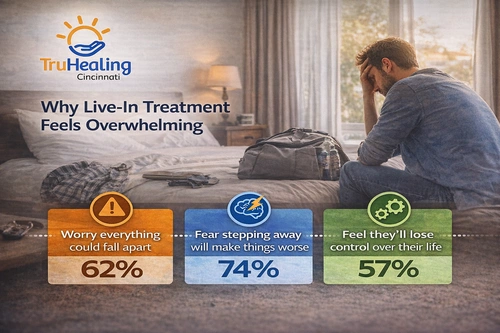
- “If I leave, everything could fall apart.”
- “I can’t afford to step away right now.”
- “What if this makes things worse instead of better?”
So instead of seeing help as support, your brain sees it as a gamble.
And when you’re already overwhelmed, you don’t gamble.
You hold on tighter to what you know—even if it’s not working.
The fear isn’t just about logistics—it’s about losing control
There’s a deeper layer underneath all of this.
It’s not just about work, family, or responsibilities.
It’s about control.
Right now, even if things feel chaotic, they’re familiar.
You know how to get through the day.
You know how to manage—at least enough to survive.
Stepping into something new means letting go of that.
And your mind immediately goes to:
- “What if I can’t handle it?”
- “What if I feel worse?”
- “What if I regret it once I’m there?”
Those thoughts aren’t weakness.
They’re your brain trying to protect you from the unknown.
You don’t have to feel ready to take a step
This is where people get stuck.
They wait until they feel confident.
Until they feel sure.
Until they feel “ready.”
But most people don’t feel that way when they start.
They feel:
- Unsure
- Hesitant
- Afraid
And they still move forward.
Not because they’ve figured everything out—but because something in them knows staying the same isn’t working either.
You don’t need certainty.
You just need a small amount of willingness.
Trying to stabilize everything on your own is exhausting
You might be telling yourself:
“I just need to get things under control first.”
But how long have you been trying to do that?
Weeks? Months? Longer?
Trying to create stability while carrying everything alone can feel like trying to stand up in a storm.
You might manage for a while.
But it takes constant effort.
Support changes that.
Not by fixing everything instantly—but by giving you something steady to stand on while things start to shift.
What people expect vs. what actually happens
A lot of people imagine stepping into care as overwhelming, rigid, or even suffocating.
And yes—parts of it can be challenging.
But what surprises most people is how human it actually feels.
People don’t walk in confident.
They walk in unsure.
They ask questions.
They take it one day at a time.
They adjust as they go.
There’s space for hesitation.
You don’t have to show up as a perfect version of someone ready to change.
The pressure you’re feeling makes sense
You’re not just making a personal decision.
You’re thinking about:
- Your responsibilities
- Your relationships
- The impact on your daily life
That’s a lot to carry.
But here’s the part that often gets missed:
Staying exactly where you are also has a cost.
It’s just a quieter one.
It shows up as:
- Ongoing stress
- Emotional exhaustion
- The constant effort of holding everything together
At some point, that cost becomes harder to ignore.
What we’ve seen in people who felt exactly like this
We’ve worked with people who were in this exact place.
Not rock bottom.
Not falling apart in obvious ways.
Just overwhelmed and unsure how to take a step without making things worse.
Some came from Lawrenceburg, Kentucky, carrying responsibilities they didn’t feel they could step away from.
They didn’t feel ready.
They didn’t feel certain.
But they felt stuck.
And what they found wasn’t everything falling apart.
It was something different.
Structure.
Support.
A chance to step out of survival mode—even briefly.
Not perfect.
But enough to start shifting things.
The first step is smaller than your mind is making it
Right now, your brain is turning this into one massive decision.
All or nothing.
But that’s not how this works.
The first step isn’t committing to everything.
It’s:
- Asking questions
- Having a conversation
- Learning what your options actually look like
You’re not locking yourself into anything.
You’re just opening a door.
And you get to decide what happens next.
You’re allowed to be scared and still want something different
This is the part people don’t say enough.
You don’t have to choose between fear and change.
They can exist at the same time.
You can:
- Doubt the process
- Feel overwhelmed
- Worry about the impact
And still take a step forward.
Those things don’t cancel each other out.
They’re part of the same moment.
The truth that might land differently
You don’t have to hit a breaking point for this to matter.
You don’t have to lose everything to justify getting help.
Feeling overwhelmed is enough.
Feeling stuck is enough.
Feeling like you can’t keep going like this—that’s enough.
Frequently Asked Questions
Why does getting help feel so overwhelming?
Because it involves change—and when your life already feels unstable, any change feels bigger and riskier.
Your brain is trying to protect you from more disruption.
Do I need to have everything figured out first?
No.
You don’t need a perfect plan.
You just need to be open to starting the process—one step at a time.
What if I’m not ready?
Most people don’t feel ready.
Waiting for that feeling can keep you stuck longer than you want.
You can move forward while still feeling unsure.
Will this make my life fall apart?
It might feel like a disruption—but often it creates the space needed to rebuild something more stable.
Short-term discomfort can lead to long-term relief.
What if I regret it?
That’s a common fear.
But staying in the same place—if it’s not working—has its own consequences.
Exploring your options doesn’t lock you in.
How do I take the first step?
Start small.
Reach out. Ask questions. Learn what support could look like for you.
You don’t have to decide everything today.
You’re not weak for feeling overwhelmed by this.
You’re human.
This is a big decision—and it’s okay that it feels that way.
But you don’t have to solve your entire life before you take a step.
Sometimes, the step is what starts to change everything.
Call (513) 429-7900 or visit our residential treatment program services in Cincinnati to learn more.