

There was a time when healing felt like erasure—like in order to get better, I had to become someone else entirely. Someone duller. Flatter. Less me. But EMDR didn’t erase me. It helped me remember the parts of myself I’d buried to survive.
If you’re in Cincinnati—or nearby in Lexington, Kentucky or Indianapolis, Indiana—and wondering if trauma therapy like EMDR could help you heal without losing yourself, I want to tell you what it was like for me.
I Thought My Pain Was the Source of My Creativity
It wasn’t just the fear of change that kept me stuck—it was the fear of losing something important. My edge. My spark. My ability to feel things deeply and turn that emotion into connection, art, or charisma.
Somewhere along the way, I started believing that my pain made me interesting. That the chaos gave me character. And that if I let go of the trauma, I’d become flat. Vanilla. Unrecognizable.
It’s not that I liked hurting. But I was terrified of what might be left if the hurt was gone.
I Didn’t Want Therapy to Steal My Fire
I used to imagine healing as a gray room. Clean, neat, quiet—but sterile. I pictured therapists asking me to unpack things I hadn’t even named yet, like I was supposed to hand over the mess and walk out with a neat little box of coping skills.
But EMDR didn’t look like that.
It wasn’t cold. It wasn’t distant. And it didn’t ask me to trade in my fire for functionality. It asked me to get still enough to listen to the part of me that never stopped wanting to survive.
What EMDR Actually Looked Like for Me
It’s wild how something that looks so simple can open so many locked doors.
EMDR (Eye Movement Desensitization and Reprocessing) uses things like eye movement, tapping, or tones to help your brain process what trauma left frozen. You start by naming a memory, image, or emotion that feels stuck—then you let your brain follow it.
At first, I felt ridiculous. Sitting there with a therapist while my eyes tracked a light bar back and forth? Tapping on my shoulders like it was some sort of healing Morse code? I was skeptical.
But over time, the weight started to shift. Not disappear. Just shift.
A memory that used to bring tears or nausea? It started feeling more like a story I was telling—not a story that was hijacking me.
EMDR Didn’t Flatten Me—It Unfroze Me
I didn’t know how much I had numbed myself to get through the day. Or how often I confused emotional intensity with truth.
I thought being overwhelmed was part of being “deep.”
But depth doesn’t mean drowning.
EMDR didn’t take away my intensity—it helped me hold it with both hands. Instead of getting lost in the flood, I learned how to notice it, feel it, and stay rooted. That changed everything.
The Real Me Was Never the Chaos—It Was the Part That Survived It
Here’s what no one told me: Your creativity, your passion, your capacity for connection—they don’t come from your trauma. They survived it.
They were always yours. The trauma just distorted the channel.
What EMDR did was clear the interference. The static. The loops that kept repeating. And underneath it? There I was.
Not a stranger. Just… me. With fewer ghosts in the room.
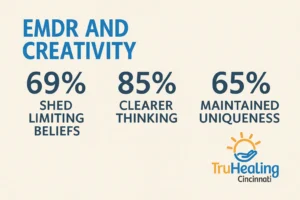
You Can Be Creative and Still Heal
This is for the person who thinks healing will make them boring.
The one who secretly wonders if sobriety will dull their color. If peace will mean they stop feeling everything so much. If trauma therapy will snuff out their magic.
I get it. I thought that too.
But here’s the truth I wish someone had told me:
You don’t lose your spark when you get healthy—you get access to it without the static. Without the spirals. Without the crash that always came after the high.
Your voice? Still yours.
Your art? Even richer, because it’s not being filtered through fear anymore.
Healing Isn’t Linear. But It’s Worth It.
There were weeks I wanted to quit. Sessions that left me exhausted. Moments when I missed the old chaos because at least it was familiar.
But over time, EMDR gave me something I hadn’t felt in years: permission to exist without always performing.
I didn’t have to bleed to be seen.
I didn’t have to suffer to be creative.
I could just… be. And that was enough.
You Don’t Have to Be in Crisis to Start
In creative circles—from music studios in Lexington to art spaces in downtown Indianapolis—so many people carry unspoken pain, convinced it’s part of their process.
But suffering isn’t a requirement for meaning.
You can heal and keep your creative edge. EMDR doesn’t dull your story—it helps you tell it with more power and clarity.
FAQs About EMDR Therapy in Cincinnati
What is EMDR therapy, and how does it work?
EMDR (Eye Movement Desensitization and Reprocessing) is a trauma therapy that helps people process distressing memories so they no longer feel stuck or overwhelming. It uses bilateral stimulation (like eye movements or tapping) to help the brain reprocess trauma in a more adaptive way.
Do I have to talk about my trauma in detail?
No. One of the unique aspects of EMDR is that you don’t have to describe your trauma out loud in detail. You’ll work with your therapist to identify key memories and sensations, but the internal processing happens quietly—at your pace.
Is EMDR only for people with “big” trauma?
Not at all. EMDR can help with a wide range of experiences, from complex PTSD to grief, anxiety, childhood wounds, or even moments that felt small but left a lasting emotional imprint. If it still impacts you, it matters.
Can EMDR help with addiction recovery?
Yes. Many people use EMDR as part of their recovery journey to address the underlying trauma that contributed to substance use. It can also help with emotional regulation, relapse prevention, and identity rebuilding.
How do I know if EMDR is right for me?
If you’ve tried talk therapy and felt stuck—or if you find yourself looping on the same emotional pain—EMDR might be worth exploring. A therapist can help assess whether it’s a good fit based on your history and goals.
You Don’t Have to Choose Between Healing and Staying You
The fear of losing yourself in healing is real. Especially when your pain has shaped so much of your story.
But you don’t have to erase your history to rewrite your future.
You just have to decide: What parts of the story do you want to carry forward? And which ones are asking to be set down?
Want to explore if EMDR could help you feel more like yourself again?
Call (888) 643-9118 to learn more about our EMDR services in Cincinnati, Lexington, or Indianapolis.