

When someone you love drinks too much, it doesn’t just hurt—it rearranges everything.
You may find yourself constantly adjusting. Keeping the peace. Making excuses. Bracing for another night that doesn’t go as planned.
And then—when something does go wrong—you wonder if you’re the one who caused it.
Did you say the wrong thing? Did you push too hard? Should you have let it go?
It’s a painful pattern, and if you’re in it, you already know:
Loving someone in active addiction is both incredibly brave and deeply exhausting.
But here’s what we want you to know at TruHealing Cincinnati’s Alcohol Addiction Treatment Program:
There is hope.
And that hope doesn’t come from blame—it comes from support. From honesty. From structure. From treatment that centers both the person who’s drinking and the person who loves them.
Let’s walk through what that actually looks like—because it’s probably gentler, more empowering, and more possible than you’ve been led to believe.
Addiction Isn’t About Weakness—It’s About Repetition and Pain
When you’re in a relationship with someone who drinks heavily, it’s easy to start questioning everything. Their stories don’t always add up. Their behavior swings between loving and defensive. And sometimes, the person you fell in love with seems like they’re nowhere to be found.
That’s the emotional reality of alcohol use disorder: it changes people’s behavior before they ever know it’s happening.
In treatment, we don’t define your loved one by their worst moments. We look at the full picture:
- What are they using alcohol to cope with?
- What emotional pain is underneath the drinking?
- What role does alcohol play in their relationships and self-worth?
Alcohol addiction treatment isn’t about forcing a new identity. It’s about gently uncovering the person who’s been buried under drinking and helping them reemerge—bit by bit, without shame.
Blame Delays Healing. Boundaries Make it Possible.
When things get tense at home, it’s easy for blame to enter the picture.
“You’re the one who’s drinking!”
“Well, you’re the one who’s always criticizing me!”
“You knew who I was when we got together!”
“I wouldn’t drink so much if you didn’t nag me all the time!”
These kinds of arguments are common—and painful. And they rarely lead to clarity. Instead, they create more confusion. Both partners end up trying to defend themselves rather than connect.
At TruHealing Cincinnati, we teach something different:
Accountability doesn’t require shame. And boundaries don’t mean punishment.
In our alcohol addiction treatment programs, we:
- Help clients take real responsibility for their choices—without losing their dignity
- Help partners learn what boundaries are theirs to hold—and which ones they can let go
- Support communication that’s direct, but non-attacking
- Foster empathy on both sides of the relationship
Blame says “this is your fault.”
Boundaries say “this is what I need in order to stay safe and connected.”
And change begins when boundaries replace blame.
Real Recovery Happens in Safe, Structured Spaces
You’ve probably tried everything already.
Asked them to cut back. Hid the bottles. Covered for them at work. Cried, yelled, begged, hoped. Maybe even given ultimatums.
And maybe none of it has stuck. Not because you didn’t try hard enough—but because addiction can’t be healed in chaos.
Treatment creates the safety that change needs to take root.
In a residential or intensive outpatient setting, your loved one gets:
- Daily support from licensed professionals
- Medical stabilization (if needed) during withdrawal
- Therapeutic exploration of why they drink and how it’s impacted others
- Peer connection with people who understand what they’re going through
- Structure, routine, and space to reconnect with themselves
In spaces like our alcohol addiction treatment program in Lexington, Kentucky, we see transformation begin—not just because someone “wants it badly enough,” but because the environment supports change instead of survival mode.
You Deserve Support, Too
Here’s something we say often—and we mean it:
The partner needs healing, too.
Even if you don’t drink. Even if you’ve “held it all together.” Even if you think your job is just to help them.
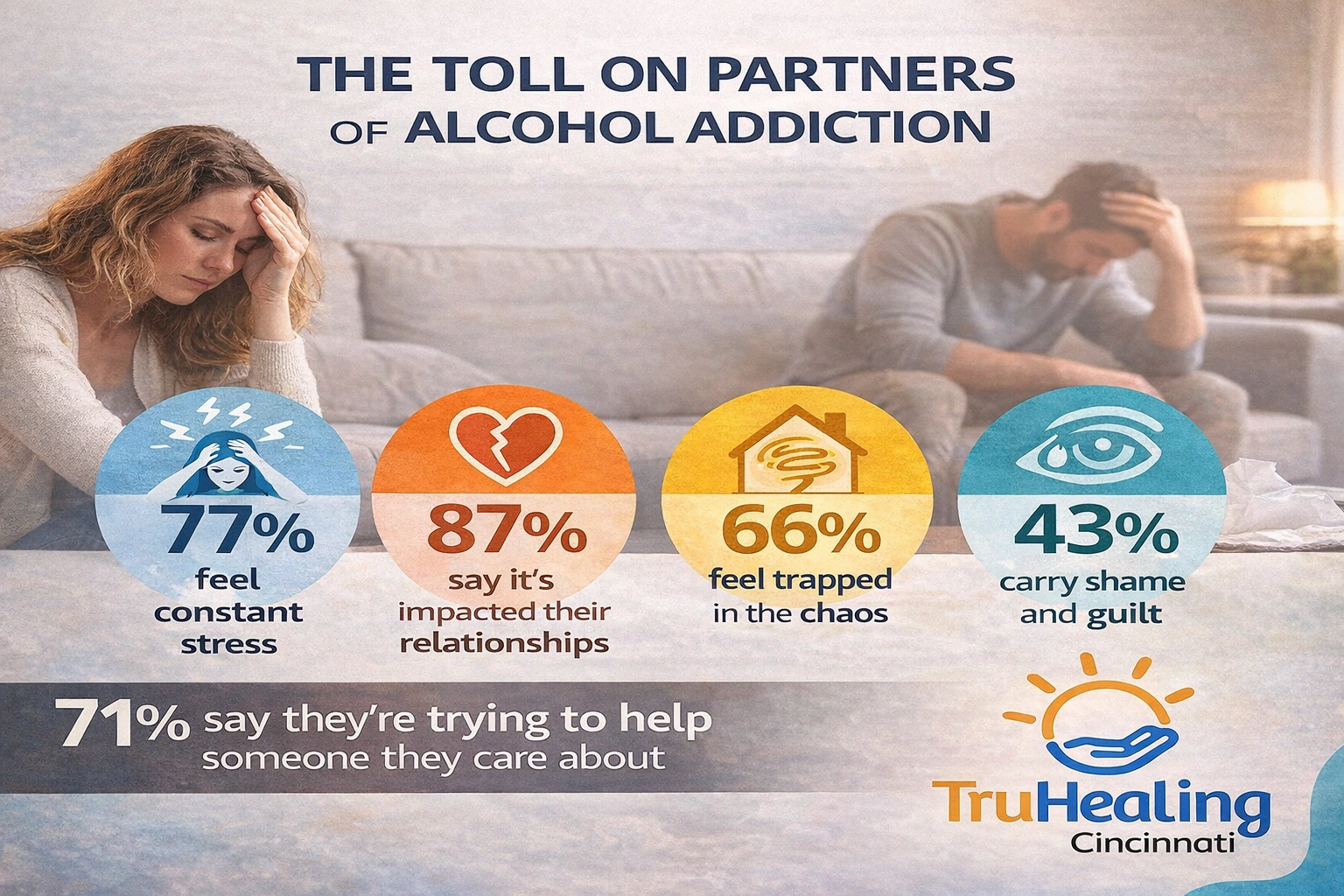
Living in the orbit of addiction causes its own form of harm. And treatment centers like TruHealing Cincinnati aren’t just here for the person using alcohol—we’re here for you.
That might look like:
- Family therapy: where you get to voice your experience and learn together
- Individual therapy referrals: for partners who need their own space to process
- Education sessions: so you understand the patterns of addiction and how to avoid enabling
- Support for boundary-setting: without guilt or conflict escalation
You don’t have to wait for a crisis to seek care. Your well-being matters now.
Love Isn’t Always Enough—But It’s a Start
You might be asking yourself:
“Is it even worth it anymore?”
Or maybe:
“If I still love them, should I just keep waiting?”
There are no simple answers. But we can tell you this:
Love alone doesn’t cure addiction. But love—when paired with truth, support, and structure—can create a powerful path toward change.
Many of the couples and families we work with don’t stay together because of treatment. They stay together because treatment gave them a chance to heal separately and rebuild together.
And some relationships don’t continue.
But that doesn’t mean treatment failed.
It means you both got the clarity and care you needed to decide what’s best.
If They’re Not Ready—That Doesn’t Mean You’re Stuck
Maybe your loved one isn’t open to treatment right now.
Maybe you’ve brought it up, and they shut down—or got defensive. Maybe they say they don’t have a problem.
That doesn’t mean you can’t do anything.
In fact, some of the most powerful shifts we see begin with the partner—not the person drinking. When you begin to reclaim your voice, needs, and boundaries, the dynamic starts to shift. And sometimes, that opens the door for real change.
You can:
- Learn how to respond without escalating
- Stop doing emotional labor that’s not yours
- Focus on your own health while making space for theirs
- Reach out to a treatment center just to ask questions
It’s okay if you’re the one initiating the search. You’re allowed to gather information even if nothing is “official” yet. We’re here for that, too.
Looking for something nearby? Alcohol addiction treatment in Lawrenceburg, Kentucky offers local access with the same respect-centered model as our Cincinnati programs.
FAQs: Supporting a Partner Through Treatment
What if they don’t believe they need help?
This is common. Denial is a protective shield, not always stubbornness. Treatment staff are trained to meet clients where they are, build trust, and gently invite self-awareness over time.
Can I attend sessions or be involved even if we’re not married?
Yes. We support all forms of partnership. Whether you’re dating, engaged, or co-parenting, your experience matters—and you can be involved in the care process.
What if treatment causes more tension at first?
It might. Recovery work can stir up old patterns. That’s why we encourage partners to have their own support during this process. Healing doesn’t always feel smooth—but that doesn’t mean it isn’t working.
How long does treatment last?
It depends. Some clients begin with a 30-day residential stay, others with outpatient services. What’s most important is matching the level of care to their needs—not rushing the process.
What if I’m still not sure if I should stay?
Then you’re exactly where you need to be. You don’t have to make a decision yet. Treatment often brings clarity—not just for the person using, but for their partner too.
You’re Not the Problem. You’re Part of the Healing Story.
Loving someone in active addiction is messy, courageous, and often isolating.
You’re carrying love, grief, loyalty, confusion, anger—and that’s a lot.
But you’re not alone. And you don’t have to keep doing this in the dark.
You can reach out without having it all figured out.
Call (888) 643-9118 or visit TruHealing Cincinnati’s Alcohol Addiction Treatment Program to learn more about how we support both individuals and the partners who walk beside them.
You matter here. Let’s start there.