
There’s a moment many people don’t talk about.
It doesn’t happen when someone decides to get help. It happens right after—when things get real. When the paperwork starts, the conversations deepen, and suddenly, medication is mentioned.
That’s often where the fear quietly steps in.
If you’ve found yourself hesitating at that point, unsure whether to move forward because of medication, you’re not alone. This is one of the most human, least-talked-about parts of starting care.
For many people exploring alcohol addiction treatment, this fear doesn’t mean something is wrong—it means something matters.
“What if this changes who I am?”
This question tends to sit just beneath the surface.
It’s not always spoken out loud, but it’s there.
Because this isn’t just about taking something new. It’s about identity. It’s about the parts of you that feel familiar—even the messy ones—and wondering if they’ll still be there.
You might find yourself thinking:
- What if I don’t feel like myself anymore?
- What if I lose my personality?
- What if I feel numb or disconnected?
These aren’t exaggerated fears. They’re deeply personal ones.
What’s important to understand is that medication, when used thoughtfully, isn’t designed to erase who you are. It’s meant to reduce the intensity of what’s overwhelming you—so more of you can actually come through.
Fear and readiness can exist at the same time
There’s a quiet misconception that you need to feel fully confident before starting anything.
But most people don’t.
Many people feel uncertain, hesitant, even resistant—and still take a step forward anyway.
Fear doesn’t cancel out readiness.
Sometimes, it sits right beside it.
You can be scared of medication and still want your life to feel different.
You can question the process and still need support.
Both things can be true.
You’re not giving up control
Another fear that often comes up is the feeling of losing control.
Like once medication is introduced, everything becomes fixed. Decided. Final.
That’s not how supportive care works.
You are allowed to:
- Ask detailed questions before agreeing to anything
- Understand exactly what a medication is meant to do
- Talk openly about side effects or concerns
- Adjust or revisit decisions over time
This isn’t something being done to you.
It’s something being discussed with you.
And that difference matters more than people expect.
The fear often comes from not knowing what to expect
Uncertainty has a way of amplifying everything.
If you don’t know how something will feel, your mind fills in the gaps—usually with worst-case scenarios.
That’s especially true with medication.
But in real-life settings, the process is rarely sudden or overwhelming. It’s often gradual. Observed. Adjusted.
People don’t get handed something and sent on their way. There’s conversation. There’s monitoring. There’s space to say, “This doesn’t feel right.”
And that ongoing support can make a significant difference in how safe the process feels.
You’re not the only one thinking this
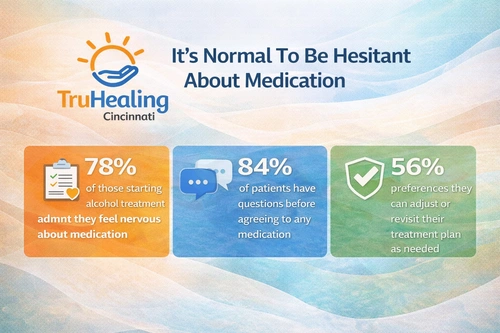
It might feel isolating, like you’re the only one hesitating while everyone else seems ready.
That’s not the reality.
Many people—especially those early in recovery—have the same concerns. Some are open about it. Many are not.
We’ve worked with individuals from places like Lawrenceburg, Kentucky who walked in with the exact same questions. People who were thoughtful, cautious, and unsure—not resistant to change, just careful about how that change happens.
And that caution isn’t a weakness. It’s awareness.
Medication is one piece—not the whole path
It’s easy to fixate on medication as the defining part of treatment.
But it’s not the full picture.
Recovery is built from multiple layers of support:
- Conversations that help you process what’s been building over time
- Structure that brings consistency back into your day
- Connection with people who understand what you’re going through
Medication, if it’s part of your plan, is just one tool among many. It’s there to support—not define—the process.
You are still the center of your recovery.
What people often notice after starting
There’s something that tends to happen—not immediately, but gradually.
The fear softens.
Not because someone forced themselves past it, but because their experience didn’t match their worst expectations.
Some people describe:
- Feeling more steady, not less like themselves
- Having clearer thoughts instead of constant overwhelm
- Being able to participate more fully in conversations and daily life
It’s not about becoming a different person.
It’s about having a little more room to breathe.
You’re allowed to go slowly
There is no rule that says you have to rush this.
You can take your time:
- Ask questions more than once
- Sit with your thoughts before making a decision
- Start small, if appropriate
- Revisit your choices as you go
This is your process.
And it should move at a pace that feels manageable—not forced.
The decision doesn’t have to be perfect
A lot of pressure comes from feeling like this decision has to be exactly right the first time.
It doesn’t.
This is not a one-shot choice. It’s part of an ongoing conversation about what helps you feel better, more stable, more like yourself.
There’s room to adjust.
There’s room to learn.
There’s room to change direction if needed.
You don’t have to get everything right. You just have to begin.
A quiet truth most people don’t say out loud
Here’s something we see often:
People are afraid medication will take something away from them.
But what it often does—when it’s the right fit—is give something back.
Energy.
Clarity.
A sense of steadiness that’s been missing for a long time.
Not by changing who you are—but by reducing what’s been weighing on you.
Frequently Asked Questions
Is it normal to be afraid of medication before starting?
Yes, it’s very normal.
Many people feel uncertain or even scared, especially if they’ve never taken medication before or have heard mixed experiences from others.
Fear usually comes from not knowing what to expect—and that’s something that can be talked through, not ignored.
Will medication change my personality?
That’s a common concern, but the goal isn’t to change who you are.
If anything, the intention is to help reduce symptoms that are interfering with your ability to feel like yourself.
If something doesn’t feel right, adjustments can always be made.
Do I have to take medication if I start treatment?
No.
Treatment is not one-size-fits-all. Medication may be recommended, but it should always be discussed—not forced.
You have a voice in every step of the process.
What if I try it and don’t like how it feels?
That’s something you can bring up right away.
Medication plans are not permanent decisions. They can be adjusted, changed, or stopped under professional guidance.
You are not locked into anything.
How long does it take to feel comfortable with the process?
It varies.
Some people feel more at ease after a few conversations. Others take longer.
What matters is that you’re given the space to move at your own pace and ask questions along the way.
What if I’m still unsure?
That’s okay.
You don’t have to feel 100% certain to start exploring your options. Sometimes, clarity comes from taking a small step—not from waiting for all the answers upfront.
Starting something like this can feel quiet, heavy, and uncertain all at once.
But you don’t have to have everything figured out today.
You don’t have to silence your fear to move forward.
You just have to be willing to take one step while it’s still there.
If you’re considering what support might look like for you, you can explore your options and take that next step in a way that respects your pace and your voice.
Call (513) 429-7900 or visit our alcohol addiction treatment in Cincinnati to learn more about.