

You felt it before you had proof.
Something in their voice. Their energy. The way they stopped meeting your eyes.
And then the realization hit—the one that feels heavier the second time:
We’re back here again.
If you’re reading this, you’re probably trying to make sense of what changed… or what didn’t.
And if you’ve already started looking into options like support for opioid use in Cincinnati, it means you’re not ignoring it.
You’re paying attention.
Even if you don’t know what to do next yet.
The Part That Hurts More the Second Time
The first time, there’s shock.
Confusion. Fear. Urgency.
The second time?
There’s something else layered on top.
Exhaustion.
You might be thinking:
We already did this.
They were doing better.
How did it slip again?
And underneath all of it:
What are we missing?
That question can feel relentless.
But it’s also the beginning of a different kind of understanding.
Why Repeating the Same Plan Often Doesn’t Work
It’s natural to go back to what you know.
The same structure.
The same conversations.
The same expectations.
Because it worked before, at least for a while.
But relapse changes the landscape.
Your child isn’t in the same place anymore.
Their experience is different now.
And the emotional weight they’re carrying is heavier.
So using the exact same approach can feel like trying to unlock a door with a key that no longer fits quite right.
Not because the key was wrong.
Because the situation has changed.
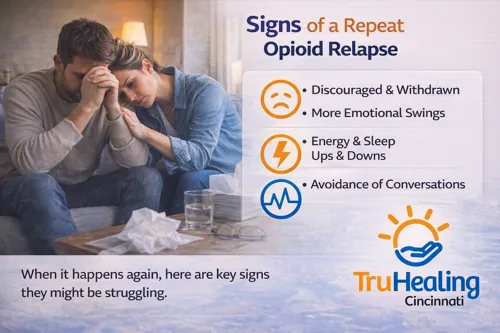
What Relapse Is Actually Showing You
It doesn’t always feel this way—but relapse can offer clarity.
Not the kind you wanted.
But the kind that reveals what still needs attention.
It might be pointing to:
- Emotional pain that wasn’t fully processed
- Triggers that weren’t fully understood
- Environments that still feel overwhelming
- A level of support that didn’t match what they needed
This isn’t about blaming anyone.
It’s about recognizing that recovery is layered.
And sometimes, the first attempt only reaches part of what’s going on.
Why Stabilizing Comes Before Everything Else
When relapse happens, there’s often urgency to “fix it.”
To get them back to where they were as quickly as possible.
But here’s what we often tell parents:
You can’t rebuild anything until things feel stable again.
Stability means:
- Their emotions aren’t constantly spiking
- Their thinking becomes clearer
- They feel grounded enough to engage
- There’s less chaos internally
Without that, every conversation feels harder.
Every plan feels fragile.
Stability isn’t the end goal.
But it’s the foundation everything else depends on.
Meeting Them Where They Are Now—Not Where They Were
This is one of the most painful shifts.
Because you’ve seen who they can be.
You’ve seen progress. Effort. Change.
And now it feels like you’re watching them move backward.
But where they are right now matters more than where they were before.
They might be:
- More guarded
- More discouraged
- More overwhelmed
- Less trusting of themselves
If you try to meet them as the version they used to be, they may feel unseen.
Meeting them where they are now creates space for them to come back toward you.
You’re Carrying More Than You Should
Parents often carry this silently.
The guilt.
The responsibility.
The pressure to fix it.
You might be asking yourself questions that don’t have clear answers.
Did I miss something?
Could I have prevented this?
What do I do differently now?
But here’s what matters:
You didn’t cause this.
And you don’t have to solve it alone.
Families from places like Indianapolis, Indiana and Knoxville, Tennessee often come in feeling exactly this way—like they’ve been holding everything together for too long.
Support isn’t about replacing you.
It’s about helping you carry what’s too heavy to hold by yourself.
What a Different Plan Actually Looks Like
A new plan doesn’t mean throwing everything out.
It means adjusting based on what you’ve learned.
That might include:
- More consistent support instead of short-term focus
- Addressing emotional and mental health more directly
- Creating a more structured environment
- Slowing things down instead of rushing progress
It’s not about doing more.
It’s about doing what fits this version of the situation.
Why This Can Still Be a Turning Point
It doesn’t feel like it right now.
It feels like a setback.
But many long-term recovery stories include moments like this.
Not because things failed.
But because something deeper needed to be addressed.
Relapse doesn’t erase progress.
It reveals where more support is needed.
And when that support aligns with what your child actually needs, things can shift in a more lasting way.
What You Can Do Without Overwhelming Yourself
You don’t have to solve everything today.
You don’t have to have the perfect plan.
You just need one step forward.
That might look like:
- Reaching out for guidance
- Asking questions about what’s different this time
- Having a conversation with your child—even if it’s imperfect
You’re not starting from zero.
You’re starting with experience.
And that matters more than you think.
You Haven’t Lost Everything You Gained
It might feel that way.
Like everything has reset.
But it hasn’t.
The progress your child made is still there.
The awareness.
The experience.
The moments where things felt different.
Relapse doesn’t erase those.
It builds on them—even if it doesn’t feel like it right now.
FAQs
Does relapse mean we failed?
No. It means something in the process needs to be adjusted. Many people experience relapse before long-term recovery.
Should we try the same treatment again?
Some parts may still help, but the overall approach often needs to change to match what your child is dealing with now.
What if my child doesn’t want help again?
That’s common. Support can still begin with you—learning how to communicate and create opportunities for them to re-engage.
How urgent is this situation?
If things feel unstable or escalating, it’s important to act sooner rather than later to help stabilize things.
Is recovery still possible after relapse?
Yes. Many people go on to long-term recovery after relapse, especially when the plan evolves.
What’s the first step I should take?
Start with a conversation—with a professional or support team—so you don’t have to figure this out alone.
Ready to Talk?
If you’re trying to figure out what to do next, you don’t have to carry that alone.
Call (513) 429-7900 or visit the page to learn more about our opioid addiction treatment in Cincinnati, Ohio.