
There’s a very specific kind of decision that happens in private.
No announcement. No plan written down.
Just a quiet thought:
I can stop this. I just need to push through it.
If you’ve been there—or you’re there right now—you’re not alone. A lot of people reach this point before ever asking for help.
And if you’ve even briefly looked into something like safe withdrawal support in Cincinnati, it likely means part of you already senses something important:
This might not be as simple as willpower.
Why Doing It Alone Feels Like the “Stronger” Choice
There’s a certain identity tied to handling things yourself.
Especially if you’ve always been independent. Capable. Private.
Quitting on your own can feel like:
- Taking control back
- Avoiding judgment
- Proving something—to yourself or others
- Keeping things contained
It can even feel more “honest.”
No help. No outside involvement. Just you, deciding enough is enough.
And that instinct—to take responsibility—isn’t wrong.
But this isn’t just a decision.
It’s a process your entire system has to go through.
The Part People Underestimate: What Happens After You Stop
Most people focus on the moment of stopping.
Not what comes after.
Because once you do stop, your body and mind don’t just… settle.
They react.
Sometimes subtly.
Sometimes intensely.
Sometimes in ways that catch you completely off guard.
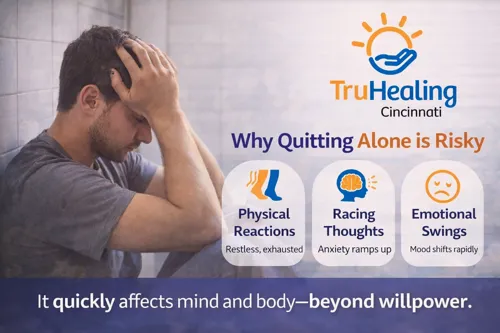
You might experience:
- Restlessness that doesn’t go away
- Sleep that feels impossible or broken
- Thoughts that won’t slow down
- Emotional swings that feel out of proportion
And the hardest part?
You’re alone with it.
No context. No reassurance. No one telling you, “This is part of it. You’re okay.”
That isolation can make everything feel louder than it actually is.
It Stops Being About Willpower Very Quickly
This is where the shift happens.
At first, it feels like a decision.
But very quickly, it becomes something else.
Your body is adjusting.
Your brain is recalibrating.
Your nervous system is trying to find balance again.
And none of that responds to willpower alone.
You can be incredibly strong—and still feel overwhelmed in that process.
Not because you’re failing.
But because you’re going through something that affects your entire system.
The Emotional Wave That Hits Unexpectedly
People expect physical discomfort.
What they don’t expect is the emotional intensity.
Things you’ve pushed down—sometimes for years—can come up quickly.
Not in a controlled way.
But all at once.
- Anxiety that feels sharper than usual
- Irritability that comes out of nowhere
- Sadness that doesn’t have a clear reason
- Thoughts that feel heavier than expected
And without support, it can feel like something is wrong.
When in reality, something is shifting.
Why People Go Back (Even When They Really Want to Stop)
This is one of the most misunderstood parts.
People don’t go back because they don’t care.
They go back because the experience becomes too intense to manage alone.
It’s not weakness.
It’s overload.
When your system is overwhelmed, your brain looks for relief.
And the fastest relief is often the thing you’re trying to stop.
That cycle can feel defeating.
But it also makes sense—when you understand what’s happening underneath it.
What Changes When You Don’t Do It Alone
The biggest difference isn’t just comfort.
It’s containment.
With support, the experience doesn’t spiral the same way.
Instead of facing everything at once, you have:
- Guidance through what your body is experiencing
- Support when emotions spike
- Structure that helps you stay grounded
- A sense of safety in the middle of something uncomfortable
It doesn’t remove the challenge.
But it changes how overwhelming it feels.
From something chaotic… to something navigable.
You Don’t Have to Earn Support by Struggling First
There’s an unspoken belief a lot of people carry:
“I should at least try on my own first.”
Like help is something you earn after it gets bad enough.
But that belief often leads people to wait longer than they need to.
You don’t have to prove anything here.
You don’t have to struggle alone to justify getting support.
And you don’t have to wait until it becomes unbearable.
If you’ve been thinking about a Medical Detox Program—even quietly—that thought matters.
It’s not random.
It’s awareness.
This Is About Safety, Not Just Success
There’s a difference between stopping and stabilizing.
Stopping is the decision.
Stabilizing is what happens after.
And without stability, the process can feel unpredictable.
That’s where support makes a real difference.
Not by taking over.
But by helping your system adjust in a way that feels safer, steadier, and more manageable.
People from places like Lawrenceburg, Kentucky and Lexington, Kentucky often come in after trying to handle things on their own first.
Not because they did anything wrong.
But because they realized something important:
This isn’t something you have to carry alone.
You’re Allowed to Choose an Easier Path Through Something Hard
This part matters.
You don’t get extra credit for doing this the hardest way possible.
You don’t have to prove strength by struggling in isolation.
Choosing support doesn’t make you less capable.
It makes the process more sustainable.
And sustainability is what actually leads to change.
What If You Didn’t Have to White-Knuckle This?
There’s a version of this where you push through everything alone.
Where every moment feels like something you have to endure.
And then there’s another version.
Where you still go through it—but with guidance, structure, and support.
Same goal.
Very different experience.
You get to choose which path you take.
FAQs
Is it safe to quit on your own?
It depends on the situation. Sometimes it can be physically or emotionally overwhelming without support. That’s why having guidance can make a big difference.
Why does it feel harder than I expected?
Because your body and mind are adjusting at the same time. It’s not just about stopping—it’s about how your system reacts afterward.
Does needing help mean I’m not strong enough?
No. It means you’re choosing a safer and more supported way through something difficult.
What if I’ve already tried to quit on my own?
That’s very common. Many people try first on their own before realizing they need more support. That doesn’t mean you failed—it means you learned.
How do I know if I need support?
If you’re unsure, that’s already a reason to explore your options. You don’t have to figure it out alone.
Will support make it easier?
It won’t remove the challenge—but it will make it more manageable, structured, and safe.
Ready to Talk?
If you’re thinking about stopping but unsure how to do it safely, you don’t have to figure that out by yourself.
Call (513) 429-7900 or visit the page to learn more about our Medical Detox Program in Cincinnati, Ohio.