

I remember hitting a point where everything looked… fine.
No chaos. No crisis. No constant damage control.
From the outside, it probably looked like things had worked.
And to be fair—they had, at least at first.
If you’ve ever taken that first step—something like getting through safe withdrawal support in Cincinnati—you know how real that shift can feel.
Relief. Stability. Space to breathe again.
But then something else showed up.
Not loud. Not dramatic.
Just a quiet, persistent feeling:
Why does everything feel… flat?
The Part No One Prepares You For
Early on, people talk about getting sober like it’s the finish line.
Like once you get through the hardest part, everything else will fall into place.
And in some ways, it does.
Life becomes more manageable.
Your mind clears.
The constant chaos settles.
But then there’s this stretch no one really explains.
Where you’re not struggling the way you used to…
…but you’re also not fully living.
It’s like the volume got turned down on everything.
Even the good parts.
I Thought I’d Feel More Than This
I expected relief to turn into joy.
Clarity to turn into motivation.
Stability to turn into fulfillment.
But instead, there was this strange middle space.
Where nothing was wrong—but nothing felt fully right either.
You’re doing what you’re supposed to do.
You’re staying consistent.
You’re holding your life together.
And still, there’s a question that lingers:
Is this all there is?
That question can feel uncomfortable to admit.
Especially when you’ve come so far.
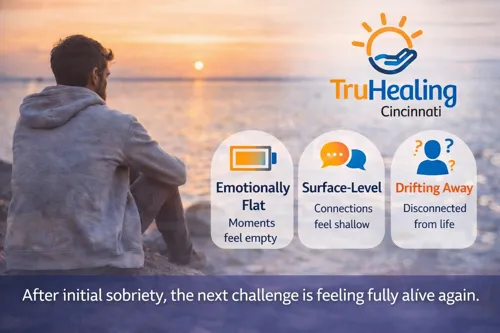
The Quiet Drift That Happens Over Time
This is where it gets tricky.
Because nothing is obviously broken.
There’s no crisis forcing you to pay attention.
But slowly, you start to notice:
- You’re going through the motions more than you’re engaged
- Conversations feel surface-level, even when they shouldn’t
- Motivation comes and goes without much reason
- You feel disconnected—even in moments that should matter
It’s not painful in a sharp way.
It’s more like a slow fade.
And because it’s subtle, it’s easy to ignore.
Why Staying Sober Isn’t the Same as Feeling Alive
This was one of the hardest truths for me to accept.
Sobriety removes something.
But it doesn’t automatically replace it.
It removes chaos.
It removes instability.
It removes the constant push and pull.
But what fills that space?
That part takes time.
And intention.
And support.
Because without that, you can end up feeling like you’ve built a life that works—but doesn’t fully feel.
The Part of Me That Was Still Avoiding Things
If I’m being honest, I wasn’t fully showing up.
Not in the way I thought I was.
I was doing the external work.
But internally?
I was still avoiding things.
Old emotions.
Unresolved patterns.
Conversations I didn’t want to have—even with myself.
And without realizing it, I had traded one form of avoidance for another.
Less destructive.
But still there.
What Started to Shift Everything
It wasn’t a big breakthrough.
It was smaller than that.
I started being honest about the fact that I wasn’t as okay as I looked.
That I felt disconnected.
That I felt flat.
That something still wasn’t clicking.
And instead of pushing that away, I stayed with it.
That’s when things began to change.
Not overnight.
But steadily.
The Difference Between Maintenance and Growth
There’s a version of recovery that’s about maintaining.
Staying on track.
Avoiding relapse.
Keeping things stable.
And that matters.
But there’s another version.
Where you start growing again.
Where you reconnect with yourself.
Where your emotions come back—not overwhelming, but real.
Where your life starts to feel like something you’re actually inside of.
That shift doesn’t happen automatically.
It happens when you go deeper than just staying sober.
Why Ongoing Support Matters More Than You Think
I used to think support was for the beginning.
For the crisis stage.
For when things were falling apart.
But what I learned is this:
Support is what keeps things from quietly drifting.
Because life doesn’t stop being complicated.
Stress still shows up.
Old habits still whisper.
Disconnection can creep in slowly.
Having a place to talk through that—to stay grounded—changes everything.
People from places like Indianapolis, Indiana and Knoxville, Tennessee often describe this same phase.
Not broken. Not struggling the way they used to.
Just… not fully connected either.
And that’s where the next layer of recovery begins.
You Didn’t Come This Far to Feel Numb
This is the part that matters most.
You didn’t do all of this work just to feel “okay.”
You didn’t fight through the hardest parts just to end up disconnected from your own life.
There’s more available than that.
More depth.
More connection.
More meaning.
But it requires stepping back in—not stepping away.
You’re Not Back at the Beginning—You’re at the Next Level
It can feel confusing.
Like something’s wrong because you’re not feeling what you expected.
But this isn’t failure.
It’s progression.
You’ve moved past survival.
Now you’re in the part where things get rebuilt.
Internally.
Emotionally.
Relationally.
And that takes a different kind of attention.
What If This Feeling Is Actually a Signal?
Instead of seeing this disconnection as a problem…
What if it’s a signal?
That there’s more to explore.
More to reconnect with.
More to understand about yourself.
Not because you’re doing something wrong.
But because you’re ready for something deeper.
You Don’t Have to Stay in This Middle Space
That in-between feeling?
It’s not permanent.
But it also doesn’t shift on its own.
It changes when you engage with it.
When you talk about it.
When you stop pretending it’s not there.
When you let someone help you navigate it.
If you’ve been through a Medical Detox Program, that step mattered.
It got you here.
But staying here—stuck between stability and disconnection—doesn’t have to be the end of your story.
FAQs
Is it normal to feel disconnected after long-term sobriety?
Yes. Many people reach a point where they feel stable but not fully engaged. It’s a common phase that often signals a need for deeper emotional work.
Why do I feel flat even though I’ve done everything right?
Because recovery isn’t just behavioral—it’s emotional and psychological. If those areas aren’t fully explored, things can feel incomplete.
Does this mean my recovery isn’t working?
No. It means you’ve reached a new stage. One that requires a different kind of attention and support.
What helps move past this phase?
Connection. Honest conversations. Continued support. And a willingness to explore what’s underneath the surface.
Can I feel fully alive again?
Yes. But it usually doesn’t happen passively. It comes from re-engaging—with yourself, your emotions, and your life.
What if I don’t know where to start?
You don’t have to know. Starting with a conversation is enough. Clarity tends to follow action—not the other way around.
Ready to Talk?
If you’ve been feeling stuck in that space between “I’m okay” and “I don’t feel like myself,” you don’t have to figure it out alone.
Call (888) 643-9118 or visit the page to learn more about our Medical Detox Program in Cincinnati, Ohio.