
You don’t have to fall apart to want a different life.
That’s one of the first things I wish more high-functioning people heard. You can be working full-time, showing up for your kids, hitting deadlines, staying social—and still feel like something’s slipping. Quietly. Privately. Underneath the surface.
At TruHealing Cincinnati, we meet a lot of clients who come to us not in crisis—but in quiet disconnection. They’re not losing everything. But they’re losing themselves in the in-between: performing, managing, holding it together.
If that’s where you are, this is for you.
Because entering an intensive outpatient program (IOP) isn’t about stopping your life—it’s about making space for a new one to start. One that doesn’t depend on substances or silence to keep going.
You’re still functioning—but it’s costing you
No one around you thinks you’re struggling.
Your boss is happy. Your friends think you’re fine. Even your family might say, “You’ve always been so strong.”
But you know what they don’t see:
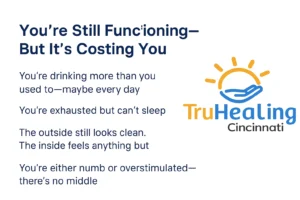
- You’re drinking more than you used to—maybe every day
- You’re exhausted but can’t sleep
- You feel disconnected from your own joy
- You’re either numb or overstimulated—there’s no middle
The outside still looks clean. The inside feels anything but.
This is what we call high-functioning harm. The damage isn’t loud. But it’s there. And it doesn’t go away by pushing harder.
Why IOP exists for people like you
Most people think treatment is a last resort. A breaking point. A total stop.
But here’s what a lot of high-functioning people don’t realize: IOP was made for the “middle ground.”
It’s for people who:
- Still have jobs, families, or responsibilities
- Don’t need 24/7 supervision or inpatient care
- Want to understand and shift their behavior without disappearing from their life
- Are starting to realize that functioning well isn’t the same as being well
At TruHealing Cincinnati, our IOP meets clients right there—in the overlap between stability and struggle. We don’t ask you to be worse to deserve help. We ask what “better” could realistically look like.
IOP isn’t a full stop. It’s a structured re-entry.
Here’s what IOP actually involves:
- 3 to 5 days per week of structured care (group therapy, individual therapy, psychiatric support)
- Morning or evening program options to fit work or family schedules
- A focus on tools—emotion regulation, stress management, relapse prevention, boundary setting
- A confidential, nonjudgmental space to get honest without losing your dignity
You don’t have to disappear into treatment. You don’t have to tell everyone what’s going on. You can work, care for your kids, and attend IOP in a way that fits your real life.
And if you’re in surrounding areas like Lawrenceburg or Lexington, Kentucky, our Cincinnati-based IOP is accessible without asking you to relocate or pause your world.
What’s under the surface doesn’t have to stay buried
Many high-functioning clients come into IOP saying the same thing:
“I’ve been carrying this for a long time.”
And they don’t mean the substance. They mean:
- Shame
- Pressure
- Resentment
- Fear
- Perfectionism
IOP isn’t just about treating behaviors. It’s about creating space to name the things you’ve had to suppress to keep performing. It’s not therapy that talks down to you. It’s care that talks with you—about how your coping came to be, what it’s protecting you from, and what else might be possible.
This isn’t about shame. It’s about clarity.
“But if I stop drinking, won’t everything fall apart?”
Let’s talk about that fear—because it’s real.
If you’ve built your routine around using “just to get through,” it can feel like sobriety is a threat. Not a gift.
And to be honest? In the beginning, it can feel worse. You’re removing the numbing layer. You’re meeting yourself without filters. That’s hard work.
But here’s what happens in IOP:
- You stop isolating
- You learn how to regulate—not just repress—your emotions
- You start identifying patterns that sabotage your own peace
- You gain language and support for things that once only felt like shame
You’re not just “stopping.” You’re building something stronger than white-knuckle control.
Starting over doesn’t mean erasing who you are
A lot of high-functioning clients ask us:
“Do I have to change everything?”
The answer is no.
You don’t lose your drive. You don’t lose your edge. You don’t lose the parts of you that work.
What you do lose is the quiet panic underneath all that competence. The hidden cost. The over-functioning. The habits that look like success but feel like survival.
Starting over in IOP means starting with you—not the persona. Not the performance. Just the part that’s been quietly asking for help.
FAQs About IOP for High-Functioning Adults
Do I need a formal diagnosis or addiction to qualify for IOP?
No. Many IOP clients enter the program with gray-area substance use, chronic burnout, or emotional distress without a formal diagnosis. If it’s interfering with your well-being, it’s valid.
Can I work while attending IOP?
Yes. TruHealing Cincinnati offers both day and evening tracks so you can continue to work, care for your family, or meet other responsibilities while getting care.
Do I have to stop drinking or using entirely before I start?
Not necessarily. We meet you where you are. Some clients enter IOP while still using and work toward clarity and reduction with support.
How long does IOP typically last?
Length varies, but most clients participate for 6–10 weeks before stepping down to outpatient or individual care. You’ll collaborate with your treatment team to decide.
Do you serve areas outside Cincinnati?
Yes. If you’re looking for an intensive outpatient program in Louisville, Kentucky, or surrounding cities, we can help you find the right fit—whether it’s in-person or through referrals.
This isn’t the end—it’s the beginning
If you’re still performing, but something inside you knows it’s not sustainable—IOP may be exactly what you’ve been avoiding and exactly what you need.
You don’t have to hit a dramatic bottom. You don’t have to stop being you. You just have to let support in.
Call (513) 429-7900 or visit our intensive outpatient program page to learn more about services in Cincinnati, Ohio.
You don’t need to stop everything.
You just need to start something better.