
You did the hardest thing already.
You showed up. You detoxed. You stayed. You made it past the fog and the fight and the early “firsts” of recovery.
But here’s the part no one warned you about:
After a while, things get… quiet.
The chaos settles. The cravings shrink. You hit your milestones.
And suddenly, you’re looking around your own life and wondering, Where did I go?
This blog isn’t for people just starting out.
This is for you—the one who’s stayed sober, stayed solid, maybe even stayed busy—but feels flat. Disconnected. Unseen. Like you’re living in grayscale.
If that hits home, you’re not broken. You’re not failing.
And you’re not alone.
Because what happens after detox is just as real—and just as worthy of care—as what came before.
Detox Was a Starting Line, Not a Finish Line
The medical detox program that launched your recovery wasn’t meant to fix everything. It was meant to clear the decks—so your body could stabilize and your brain could start working again.
And for a while, that clarity felt like magic.
You were sleeping better. Thinking straighter. You finally felt like yourself.
But now you’re months—or years—into this thing, and that “yourself” you were chasing feels like it slipped out the back door.
That’s not failure. That’s the next layer.
Real recovery doesn’t end with clean time. It deepens. It matures. And sometimes, it stalls.
Especially when you’ve been holding it together for so long that you forgot you still get to need things.
Disconnection Isn’t a Sign You’re Doing It Wrong
Let’s kill the myth right now: you don’t have to relapse to be struggling.
Sometimes the real low comes not in chaos, but in quiet.
You show up to your job. You text people back. You do the right things.
But inside? You’re numb. Irritable. Going through the motions.
And the worst part? You feel guilty for feeling this way—because you “should be grateful.”
That’s the trap so many long-term alumni fall into.
The unspoken pressure to be the success story. The strong one. The one who proves it works.
But strength doesn’t mean silence. And healing doesn’t mean you never hit dry spells.
If you’re in one? It might be time to come back and check in—not because you’re in crisis, but because your soul is asking for more.
The Same Place That Helped You Detox Can Still Help You Feel Again
You already know we were there when you needed stability, safety, and structure. Our medical detox program gave you the foundation to begin again.
But our relationship with you didn’t end when you discharged.
At TruHealing Cincinnati, we’ve walked with people through every season of recovery—including this one.
The “middle.” The stretch of time where the urgency is gone, but so is the spark. Where you’ve got tools, but not much to say in meetings. Where everyone thinks you’re good—but inside, you’re not sure why you feel so flat.
This is still recovery. And it still deserves attention.
You’re Allowed to Want More Than Just “Not Using”
Sobriety is the floor, not the ceiling.
Maybe you got clean to get your life back. But now that you have it, something still feels off. You’re not hiding in substances—but you’re not exactly lit up by life either.
This is where deeper work begins.
Not because you did it wrong—but because healing happens in layers.
You don’t have to keep pushing through the dullness.
You’re allowed to want joy, connection, even beauty. Not just safety.
And you’re allowed to reach out—even if it’s been a long time.
Been Gone a While? You’re Still Welcome Here.
Here’s the thing about real recovery spaces: they don’t close their doors when you stop showing up.
We don’t track your silence. We don’t count the weeks. We just care that you’re here now.
If you want to talk, we’ll listen.
If you want to reconnect with a therapist, group, or alumni support—we’ve got options.
If you don’t know what you need, but you know you don’t want to keep coasting—we’ll figure it out together.
And if you’re supporting someone else through the fog—maybe they’re looking for a medical detox program in Louisville, Kentucky, or they live right here in Cincinnati, Ohio—we’re ready to walk that road with them, too.
Sometimes coming back to recovery means helping someone else begin.
What Does “Reconnecting” Actually Look Like?
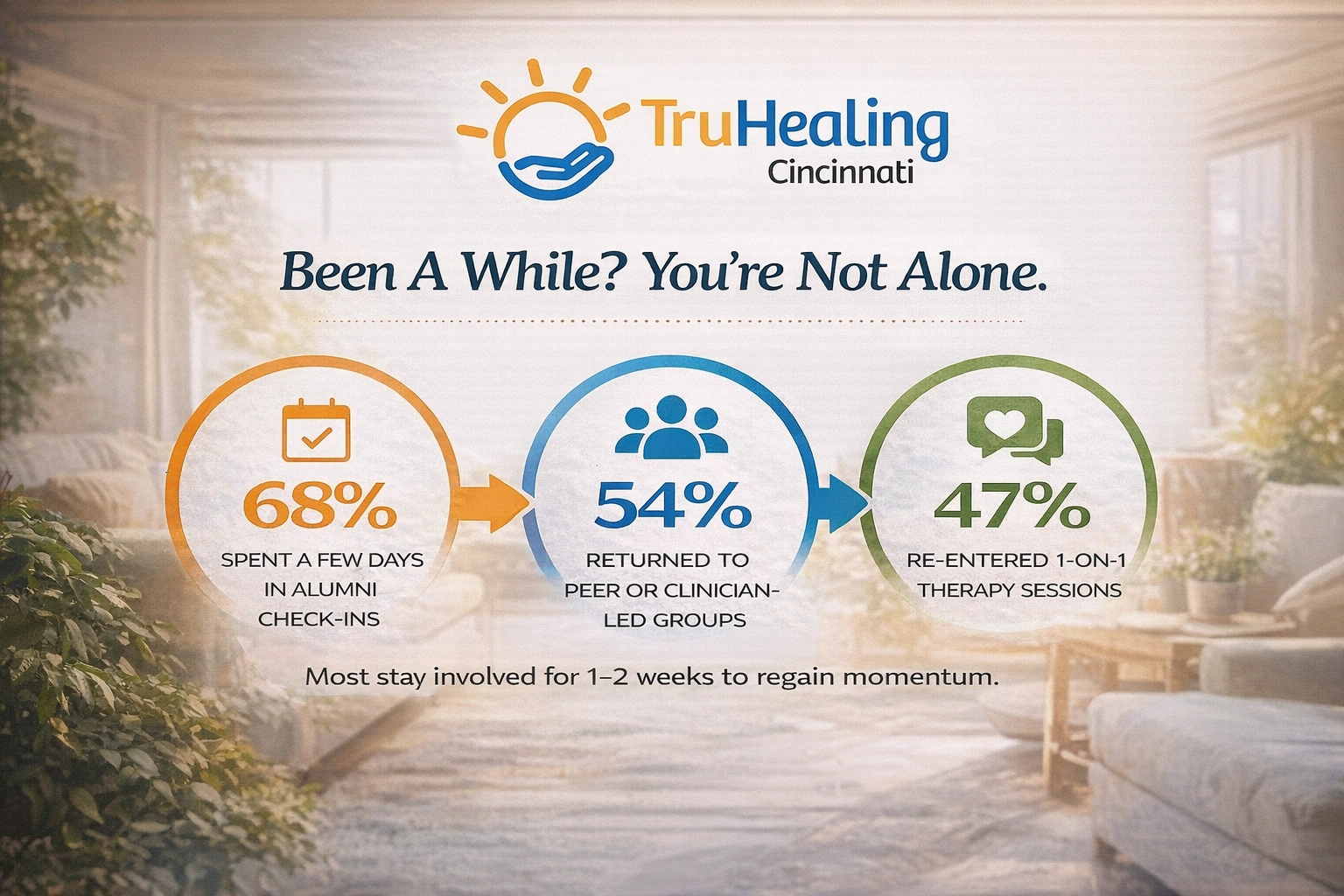
Let’s get practical. You don’t have to re-enter a full program to feel supported again. Here are a few ways alumni reconnect with us:
- Alumni check-ins: A short, informal conversation with someone who remembers you—and gets it.
- Group re-entry: Joining a peer-led or clinician-led group just to shake the dust off.
- One-on-one therapy refresh: Meeting with a trusted clinician to explore what’s really going on beneath the disconnection.
- Event support: Rejoining alumni events or volunteer opportunities that remind you why this life matters.
And sometimes, just walking through familiar doors and saying, “Hey, it’s been a while,” is enough to shift something inside.
You don’t owe us a perfect update. You just owe yourself the honesty of asking: Do I feel alive right now—or just sober?
A Few Things You Don’t Need to Explain to Us
- That you’re technically fine, but emotionally checked out
- That you feel like a sponsor, not a person
- That you’ve outgrown some recovery spaces but still need connection
- That success feels weirdly hollow sometimes
- That you’re still proud of yourself—and still tired
All of this is valid. All of this is part of it.
Recovery isn’t a straight line.
It’s a living thing. It needs tending—even years in.
FAQs: Honest Answers for Long-Term Alumni
Do I have to be using again to come back?
Not at all. In fact, most of the alumni who reconnect with us aren’t using—they’re just feeling stuck, flat, or emotionally lost. That’s a valid reason to reach out.
Is there a program for people who’ve been sober a long time?
Yes. We offer alumni support, therapy refreshers, group access, and individualized plans that meet you where you are—not where you were on Day 1.
What if I feel ashamed for struggling this far in?
Then you’re human. Shame loves isolation. The moment you say it out loud, it loses power. You’re not weak for needing help—you’re wise for asking.
Can I come back just to talk—not to re-enroll in treatment?
Absolutely. A conversation is just a conversation. You’ll never be pressured into more than you want or need.
What if I’ve moved or am supporting someone else now?
Whether you’re in Cincinnati or helping someone looking for detox in another city, we can still be a resource. Our reach goes beyond our walls.
Call (888) 643-9118 or visit TruHealing Cincinnati’s Medical Detox Program to reconnect—whether it’s for yourself, a loved one, or just to remember who you were when you first said yes to healing. You don’t have to go back to the beginning. You just have to stop pretending you’re fine when you’re not. We’re still here.